The Fine Print of the Gulf-Africa Corridor. What the UAE's Contracts Actually Say About Ownership
Behind $71 Billion in Announced Capital, the Concession Agreements Reveal Who Really Controls the Assets

– 10 min read


Behind $71 Billion in Announced Capital, the Concession Agreements Reveal Who Really Controls the Assets

KEY TAKEAWAYS
The headline numbers behind the Gulf-to-Africa infrastructure corridor are, by now, familiar to any serious reader of African markets.
What is less familiar, and far more consequential for diaspora capital allocators, is what the underlying agreements actually say about ownership, foreign-shareholding limits, concession duration, and who captures the recurring cash flow once a port, terminal, or power plant is built.
This is the layer of the story that headline-driven coverage skips.
It is also the layer that determines whether "diaspora capital allocator" becomes a meaningful category of investor in this corridor, or remains a spectator category watching sovereign-to-sovereign deals from the outside.
The concession and investment record across the continent is now extensive enough to analyze as a pattern rather than a series of isolated announcements.
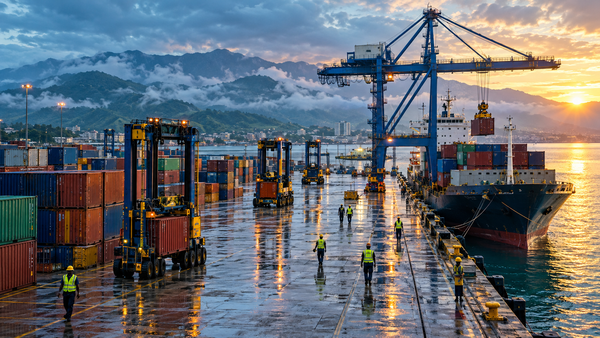
AD Ports Group holds a 30-year, extendable concession to operate the New East Mole Terminal in Pointe-Noire, Republic of Congo, backed by more than $500 million in committed investment over the life of the agreement, with roughly $220 million allocated to the first phase alone (AD Ports Group, June 20, 2023).
In May 2026, AD Ports awarded a further $200 million in contracts for marine works, topside infrastructure, and crane systems at that same terminal, split between a local joint venture and Shanghai Zhenhua Heavy Industries (AD Ports Group, May 17, 2026).
In the Democratic Republic of Congo, AD Ports signed Heads of Terms in February 2026 with the DRC's Ministry of Transport and the National Transport Office to develop a multipurpose terminal at Matadi Port on the Congo River, though the parties disclosed no financial or technical details at signing (AD Ports Group, February 1, 2026; Ecofin Agency, February 3, 2026).
That absence of disclosed terms is itself a data point.
The largest port announcements in this corridor frequently precede, by months or years, the point at which equity splits and revenue-sharing structures become public.
On the energy side, Masdar's Africa platform has moved from memorandum to measurable structure.
The company's $10 billion clean-energy commitment across the continent is split specifically into $2 billion of direct equity and $8 billion mobilized through project finance, according to Masdar's own September 2023 announcement with pan-African infrastructure platform Africa50 (Masdar, September 6, 2023).
That equity-to-project-finance ratio is the clearest publicly disclosed template in the entire corridor for how a Gulf institution structures its own capital stack, and it is instructive.