Stephen Smith and William Whipper: The Lumber Firm That Owned 22 Railcars and Ran Them Twice
Stephen Smith and William Whipper built Smith, Whipper & Co. into a lumber and coal firm grossing $100,000 a year with 22 privately owned railcars — and used the same asset base to move people north. A business analysis of open-access infrastructure, nominee control, and dual-use logistics.
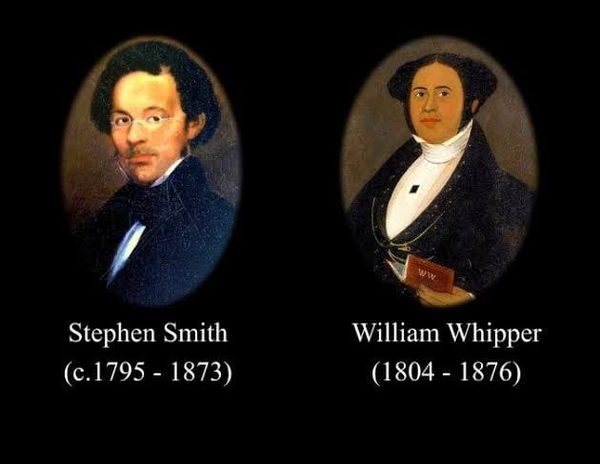
Portraits of Stephen Smith and William Whipper. Combined graphic courtesy of Lancaster History. Stephen Smith image: Oil painting by James Stidun, courtesy of Historical Society of Pennsylvania Collection. Whipper image: Attributed to William Matthew Prior (1806 – 1873). Collection of the Fenimore Art Museum, Cooperstown, NY. Gift of Stephen C. Clark.
The Business Opportunity Hidden Inside the Railroad
There is a version of this story that gets told every February, and it is not a business story. It is a moral story about two brave men who hid people in boxcars. The moral story is true.
It is also the least interesting thing about them.
The business story is this.
"You must know that your presence is not agreeable… as you are considered an injury to the real value of property in Columbia. You have better take the hint"
Between roughly 1834 and 1857, the Commonwealth of Pennsylvania operated the Philadelphia & Columbia Railroad — the first railroad in the world built by a government rather than by private enterprise — as a public toll road.
The state owned the track and, eventually, the locomotives.
For a window of about twenty-three years, the single most valuable industrial asset in eastern Pennsylvania was available on an open-access basis to anyone with capital and freight — with no charter to obtain, no legislature to petition, no board to be voted onto, and, critically, no clause about the color of the owner.
In a state that in 1838 rewrote its constitution specifically to strip Black men of the vote, the railroad's toll schedule was the one document in Pennsylvania that did not care who Stephen Smith was.
He and William Whipper took the offer.
By 1849 the firm of Smith and Whipper owned twenty-two railcars, moving thousands of tons of coal and 2.25 million board feet of lumber a year (Pennsylvania Historical and Museum Commission).
That is a firm with real scale in the industrial economy of the antebellum North, built by a man who had been someone's indentured property and a man whose mother had been someone's house servant.
And the cars ran twice.
Loaded with lumber eastbound to Philadelphia and Baltimore, they were also fitted, by 1838, with a false wall inside one end — turning a freight asset into a passenger asset that no bill of lading recorded (Underground Railroad historical marker, Lancaster).
The trip to Philadelphia took about eight hours. Smith and Whipper had built the only vertically integrated logistics network in America that carried its own liberation as backhaul.
The Market Was Hostile. The Infrastructure Was Open.
A Free State With Two Sets of Rules
Pennsylvania in the 1830s was a free state that behaved like a border state, because it was one. The Susquehanna runs north out of Maryland, and Columbia sat at the point where the river met the state's new rail spine — which is precisely why it was both a lumber town and a crossing point for people escaping Maryland and Virginia.
The legal environment for a Black businessman there deteriorated over exactly the years the firm was scaling.
Pennsylvania's revised constitution took effect on October 9, 1838, inserting the word "white" before "freeman" and disenfranchising Black voters who had previously held the franchise (Wikipedia, Stephen Smith).
Twelve years later the federal Fugitive Slave Act of 1850 made the entire commonwealth a jurisdiction where a Black resident's freedom was a matter of documentary proof and a commissioner's discretion. Smith, by then one of the wealthiest men in the state, left for Canada after its passage and came back only after some interval (Lykens Valley History).
💡
...the partners modified boxcars by fitting a false wall inside one end. Concealed passengers reached Philadelphia in about eight hours.
Understand what that means on a balance sheet.
Smith and Whipper were running a capital-intensive business — yards, inventory, rolling stock, bank stock, bridge stock, real estate — in a jurisdiction where the owners of that capital could be seized as property.
There is no modern equivalent.
The closest analogy is operating a heavy-asset business under a government that may at any time declare you a non-person, with no recourse and no insurance market.
When the Market Tried to Force a Sale
On August 23, 1834, white working men in Columbia met and resolved that the borough's Black property owners should sell all their holdings and leave. Rioting ran three nights and drove Black residents into the surrounding countryside (PHMC).
A second wave that October destroyed Smith's office on Front Street, reported in the Columbia Spy of October 4, 1834. All eight white men arrested were acquitted (Wikipedia, Stephen Smith).
By 1833 Smith had been, by a wide margin, the wealthiest of Columbia's thirty-five Black property owners. That is the point.
The 1834 riots were not random racial violence; they were an attempt at forced divestiture by a group of white artisans and laborers who correctly identified Black property accumulation as the thing they wanted stopped.
The Columbia lumberyard of Smith and Whipper was burned on two separate occasions in opposition to their abolitionist activities (Juliet E.K. Walker, Business History Review).
Whipper recorded that two attempts were made to fire the yard, and that local merchants complained he was injuring local trade by persuading laborers to leave (William Still, The Underground Railroad, 1872).
Arson was not an aberration in this business. It was a recurring, uninsurable operating expense.
When the Banks Would Not Finance Him, He Bought the Bank
There was no bank a Black borrower in Lancaster County could walk into as an equal. Smith's response was not to find one; it was to buy one. He served on the board of the Columbia Bank and was possibly its largest stockholder, and he was the largest stakeholder in the Columbia-Wrightsville Bridge Company.
Bank rules barred him from the presidency of either. He was, however, able to name the white man who took the bank's chair (Wikipedia, Stephen Smith).
That arrangement — economic ownership divorced from titular control, with the title held by a nominee the owner selects — is the defining structural feature of his career, and we will return to it.
ARCHITECTS & BUILDERS
Know the history. Understand the architecture. Build what comes next.
Explore the people, enterprises, institutions, and economic ideas that shaped business across Africa and the global African diaspora.
Fifteen Years of Operating Experience Before Ownership
Stephen Smith was born into slavery in Dauphin County around 1795 to a mother named Nancy — recorded elsewhere as Mary — Smith; his father's name was never written down (Lykens Valley History).
On July 10, 1801, as a small child, he was indentured to Brevet Major Thomas Boude (1752–1822), a Revolutionary War officer, congressman, and Columbia lumber merchant (Wikipedia, Stephen Smith; PHMC).
He was put to work in the lumberyards on the Columbia waterfront. He was good enough at it that Boude eventually handed him management of the entire lumber business (Pennsylvania Civil War Trails).
This is the part of the story most retellings skip past, and it is the most commercially consequential fact in it.
Smith did not learn to be a laborer.
He learned to be a general manager — purchasing, inventory, grading, pricing, credit, customer relationships, river logistics — in a specific regional commodity trade, over roughly fifteen years, before he owned a dollar of it.
When he bought his freedom he was not entering an industry.
He was continuing a job he already ran, on his own account.
The First Capital Stack: $50 and Six Years of Retained Earnings
He married, kept working in the yards, saved, and by 1822 had opened his own lumber business in Columbia (Pennsylvania Civil War Trails).
Fifty dollars of debt, at roughly age twenty-one, to acquire the legal capacity to own the output of his own labor. Then six years of retained earnings before he hung out a sign.
The subsequent $500,000 credit rating is remarkable, but the six years is the part worth studying: he did not launch on borrowed money. He launched on accumulated wage income in a trade where he already knew every supplier and every buyer.
Whipper's early career was a sequence of correctly identified niches.
In Philadelphia he worked as a steam scourer — an operator of a then-new process for cleaning clothing, which is to say he took a job in an emerging technology. In 1834 he opened a free-labor and temperance grocery: a store stocked on the explicit principle of excluding slave-produced goods, which made it simultaneously a retail business and a political instrument.
He drafted the constitution of the Reading Room Society, co-founded the American Moral Reform Society in 1835, and edited The National Reformer (Wikipedia, William Whipper).
He moved to Columbia in 1835 and stayed roughly three decades, in a house at the end of the Columbia-Wrightsville Bridge. In 1836 he married Harriet Smith, connecting him to Stephen Smith by marriage, and joined the lumber business (Columbia Historic Preservation Society; Susquehanna National Heritage Area).
The division of labor that followed is the cleanest illustration in nineteenth-century Black business of a founder-operator handoff.
In 1842 Smith expanded to Philadelphia and placed Whipper in charge of the Columbia operations (PHMC). Smith moved to the demand center and the capital markets; Whipper stayed at the supply and transport node. Smith went long real estate and securities; Whipper ran the yards, the labor force, and the cars.
The Exit Failed Because the Asset Had No Buyer
The most revealing document in the entire record is a newspaper advertisement.
After the August 1834 riots, on September 19, Smith placed a notice in the Columbia Spy and the Lancaster Journal:
I offer my entire stock of lumber, either wholesale or retail, at a reduced price, as I am determined to close my business at Columbia…. Any person desirous of entering into the lumber trade extensively can have the entire stock at a great bargain; or persons intending to open yards along the line of the railroad, or builders, will find it to their advantage to call on me or my agent at my yard, as I am desirous of disposing of the above as soon as possible.
He was liquidating. Whole stock, wholesale or retail, at a discount, marketed to anyone who wanted to enter the trade or open a yard along the rail line.
Then, months later, he published the sequel:
Now upwards of six months have elapsed, and I have not been favored with an opportunity of completing my original design. I do, therefore, under the guidance of a benign Providence, and with renewed confidence in the integrity and virtue of my fellow-citizens, make known to my patrons and the public generally, not only in the county of Lancaster, but Philadelphia, Baltimore, and elsewhere, that I shall continue to prosecute my business with usual vigor…
P.S. — I do most cheerfully return my hearty thanks to my customers for the very liberal patronage I have always received, but more specially for their favors during that eventful period of excitement. For never before has there been a time when I could place such a just estimation on the value of friends.
Strip away the period diction and this is a distressed-sale process that found no bid. Smith tried to sell a going concern into a market that had just proved it would burn his office, and discovered the obvious: the same violence that made him want out destroyed the asset's transferable value.
No buyer would pay for a business whose principal risk was the mob, and no white buyer needed to — waiting was free.
So he stayed, because staying was the only option that preserved value, and he wrote the announcement of that constraint as a statement of confidence in his neighbors. Note also what he did with the second notice's distribution list: Lancaster County, Philadelphia, Baltimore, and elsewhere. He used a forced re-commitment as a customer-retention letter to his entire regional book.
Sixteen months later, on January 15, 1836, he wrote to State Senator John Strohm asking for help "in the passage of such laws as will aid in securing and protecting the citizens of this Commonwealth from those acts of popular violence," describing himself as "a common sufferer" (PHMC).
Having failed to exit, he moved to change the operating environment.
That is the correct sequence, and most operators never get to step two.
THE BLACK EXECUTIVE JOURNAL™ — THE MAGAZINE
Launching October 12, 2026 Shipping to more than 150 countries worldwide.
The Business Was Bigger Than Lumber
From Lumberyard to Diversified Asset Platform
The firm was never a single-product lumber dealer. By the 1850s the revenue base looked like this:
Line
Evidence
Lumber wholesale and retail
2.25 million board feet moved annually by 1849 (PHMC)
Coal
Thousands of tons annually by 1849; coal yards and coal-bearing land (PHMC; Lykens Valley)
Rail freight capacity
22 privately owned cars; described elsewhere as "fine merchantmen cars" running Philadelphia to Baltimore (Encyclopedia.com)
At $100,000 of annual sales against a Dun-assessed net worth of $500,000, the firm was carrying roughly five dollars of assets for every dollar of revenue.
That ratio is not a trading business.
It is an asset-heavy infrastructure and property business with a commodity distribution operation attached — which is exactly the shape you would expect from a man who had watched a mob take his office and concluded that owning hard assets in multiple jurisdictions was the only durable form of security available to him.
The Real Advantage Was Access to the Rails
This is the piece of the architecture that deserves the closest attention, because it is the one that was genuinely original.
Pennsylvania chartered its first railroad in March 1823, authorizing an 82-mile line from Philadelphia through Lancaster to Columbia on the Susquehanna as part of the Main Line of Public Works.
It became operational in September 1832, initially with horse-drawn carts on a twenty-mile section; the first locomotive ran Philadelphia to Lancaster in April 1834, and locomotives displaced horsepower by 1836.
Throughout, it was administered as a public toll road by the Canal Commission, with individuals and companies paying tolls for use of the rails and supplying their own rolling stock and freight facilities (Lower Merion Historical Society).
Smith and Whipper's twenty-two cars made them a significant private operator on the line — for scale, William C. Goodridge of York, a Black barber-turned-merchant working the same system in league with Smith and Whipper, owned ten first-rate merchandise cars in 1849 (Underground Railroad historical marker).
What the firm bought, in economic terms, was capacity on a state-subsidized trunk line without needing state permission to be a railroad. They took none of the construction risk — Pennsylvania had absorbed that, at a cost the Commonwealth badly underestimated.
They took none of the motive-power capital cost. They paid a variable toll per ton-mile, tied directly to volume, and they captured the margin between Susquehanna-basin stumpage and coal at one end and Philadelphia and Baltimore building demand at the other.
It was a fixed-cost-light, volume-geared position on the fastest-growing freight corridor in the region, and it was open to them because the tariff had no race clause.
The window closed. In 1857 the Pennsylvania Railroad bought the Philadelphia & Columbia for $7.5 million, because the Commonwealth wanted out of a business whose maintenance and operating costs it had never forecast (Lower Merion Historical Society).
Open access ended; an integrated private carrier replaced it, and private cars coupling to public engines became a historical curiosity.
That is the same year Dun's reporters priced Smith at $500,000 — and it is not a coincidence that his center of gravity had already shifted to Philadelphia real estate and securities fifteen years earlier.
Whether by design or instinct, he had migrated his capital out of a regime before the regime disappeared.
Own the Economics. Let Someone Else Hold the Title.
Smith could not be president of the Columbia Bank.
He could be its largest shareholder and a director, and he could select the white man who would be president (Wikipedia, Stephen Smith).
The same pattern held at the Columbia-Wrightsville Bridge Company, where he was the largest stakeholder and likewise barred from the chair.
Separate the two things a rule like that can take from you. It can take the title, and it can take control. Smith conceded the first entirely and defended the second completely. He accepted every humiliation of form in exchange for the substance — capital allocation, credit access, board influence, and the identity of the man in the chair.
The commercial payoff was direct: a lumber and coal firm whose principal was a director and largest shareholder of the local bank had a working-capital line that no other Black-owned business of the era could replicate.
He had solved his own credit problem by buying the lender.
The Same Infrastructure Served Business and Liberation
Whipper ran the labor side, and he ran it in a way that fused the firm's commercial and clandestine operations into one system.
In his own account, given to William Still and published in 1872, he sheltered "from one to seventeen at a time in a single night," "passed hundreds to the land of freedom," and employed many freedom seekers in his lumberyards at a living wage (William Still, The Underground Railroad, 1872).
That last clause is the operationally decisive one.
Columbia's lumber and coal yards needed labor. People arriving from Maryland needed wages, cover, and time.
Whipper matched the two.
Freedom seekers entered the payroll of a business whose owner had every reason to protect them, earned money for the next leg, and in many cases moved on to Canada — which Whipper always urged, correctly judging Pennsylvania unsafe.
Local merchants complained that he was injuring local trade by persuading laborers to leave (William Still, 1872). They were describing, accurately, a competitor who had a labor pipeline they could not access and a retention policy that deliberately let workers go north.
By 1838, with the help of Columbia's William Wright, the partners modified boxcars by fitting a false wall inside one end. Concealed passengers reached Philadelphia in about eight hours. Goodridge used the same method for the following twenty years (Underground Railroad historical marker).
This is dual-use infrastructure in the strict sense: a single asset, one revenue-generating function and one covert function, with the commercial function paying for and legitimizing the covert one.
Twenty-two cars of lumber and coal moving east on a public toll road generated the freight volume, the tolls, the schedule regularity, and the commercial explanation that made the second function invisible.
No separate network had to be financed.
No unexplained expenditure appeared.
The cover was not a cover story; it was a real business at real scale.
Then He Extended the Network Across the Border
The network did not stop at Philadelphia. Whipper visited the Dawn Settlement in 1853, bought property, and started a venture in Dresden, Ontario, where he and Smith built a warehouse and other holdings supervised by his brother-in-law James Hollensworth.
In the late 1850s or early 1860s Whipper and the Detroit operator George DeBaptiste purchased the steamboat T. Whitney, carrying lumber and escapees between Sandusky, Detroit, and Amherstburg, with Samuel C. Watson involved in its management (Wikipedia, William Whipper).
Trace the resulting chain: timber and coal land in the Susquehanna watershed, yards at Columbia, privately owned cars east to Philadelphia and Baltimore, a Lake Erie steamer, a warehouse at Dresden, and a trained family operator selling lumber in Chatham.
That is a cross-border, multimodal, family-staffed distribution network assembled by two Black men in a period when neither could vote in his own state — and every link in it doubled as a segment of an escape route ending in British territory.
Every Asset Answered a Specific Risk
The firm's risk posture is best read as a set of deliberate answers to threats with no market solution.
Arson was uninsurable, so the response was geographic dispersion — Columbia, Philadelphia, Lancaster, central Pennsylvania timberland, Ontario, Cape May. Burn one yard and the enterprise survives.
Legal disenfranchisement was unwinnable, so the response was the nominee structure: own the economics, rent the title.
Personal seizure risk under the 1850 Act was absolute, so the response was mobility and offshore assets. Smith went to Canada; the firm already had property there.
And the succession risk of a family with no surviving children was met by training a nephew. Smith and Harriet's line did not continue — Whipper's own daughter Harriet, born February 15, 1837, appears to have died before adulthood (Columbia Historic Preservation Society) — so the operating knowledge went to James Whipper Purnell, who took it to Chatham.
One risk they did not hedge, and could not.
Smith's $9,000 stake in the Columbia-Wrightsville Bridge became a total loss on June 28, 1863, when the bridge was burned to stop Confederate troops from crossing into Lancaster County. A claim was filed with the federal government. Neither the bank nor its investors were ever repaid (Pennsylvania Civil War Trails).
Sit with that.
The largest shareholder in an infrastructure asset watched his own side destroy it as a military necessity in a war fought over the institution he had spent thirty years and a fortune undermining — and received nothing.
It is the most precise statement of his position available: he bore the costs of the Union cause as an investor, a shipper, a target, and a claimant, and the compensation never came.
When the Mission Became a Balance-Sheet Line Item
Whipper's property was valued at $23,800 by 1860, and he held investments in the Reading and Columbia Railroad (Columbia Historic Preservation Society).
Against that figure, set his own accounting: "directly or indirectly from 1847 to 1860, I have contributed from my earnings one thousand dollars annually, and for the five years during the war a like amount." And: "I would prefer to be penniless in the streets than to have withheld a single hour's labor or a dollar from the sacred cause" (William Still, 1872).
Fourteen years at $1,000 plus five war years is roughly $19,000 of cumulative outlay against a net worth that peaked, in the records available, at $23,800. He was running the Underground Railroad as an annual line item worth something close to four percent of his balance sheet every single year, sustained for nearly two decades, in a business subject to arson.
No modern corporate giving program operates at that intensity, and none of them faced a downside case where the founder is dragged south in chains.
The Business Ended. The Capital Architecture Survived.
He Turned Wealth Into an Institution
The institution outlasted the firm, which is usually how this goes.
The Home for Aged and Infirm Colored Persons was organized on September 14, 1864, beginning with a three-story dwelling at 340 South Front Street bought for $5,000 and housing twenty-five residents, governed by an interracial board that included Sarah Mapps Douglass and William Still (Philadelphia Historical Commission nomination; Library Company of Philadelphia).
In 1869, encouraged by his wife Harriet, Smith donated about an acre of land and within two years conveyed ground rents valued at $28,000, financing the original Smith Building.
Smith had also stepped in to save the adjacent Olive Cemetery, an African American burial ground established in 1849, when it went under the sheriff's hammer in 1857.
Upon his death he left the greater part of his estate to the Home and to the Zion Mission in Philadelphia, and to Black churches in Chester, Pennsylvania, and Cape May, New Jersey (PHMC).
The Home was officially renamed the Stephen Smith Home in 1957, later operated as the Stephen Smith Geriatric Center, and the complex at 4501 Poplar Street still stands (Philadelphia Historical Commission nomination).
He gave a real-estate operator's gift. Not a cash grant to be spent down, but land plus ground rents — an endowment structured as a perpetual income stream secured on Philadelphia property.
It is the same instinct that built the firm, applied to charity: own the asset, live on the yield.
The Operating Model Had an Expiration Date
The firm itself did not survive its founders in any recognizable form, and the record does not show a successor entity. There is no Smith, Whipper & Co. in the twentieth century.
Several reasons are visible.
The open-access rail regime that gave the business its structural edge was extinguished in 1857. The Columbia riots had already established that a Black-owned industrial business in a small Pennsylvania borough had no defensible franchise value.
There was no surviving direct heir on either side. And Smith's own capital allocation moved steadily from operations toward securities, rents, and philanthropy — a deliberate wind-down of an operating business into a portfolio and an endowment.
Whipper made one more attempt at institutional change.
In 1866 he joined Frederick Douglass in a delegation to President Andrew Johnson on Black suffrage. Johnson refused them (Wikipedia, William Whipper). He returned to Philadelphia after the war, keeping his Columbia property, and died there on March 9, 1876.
Smith died in Philadelphia in 1873 and was buried at Olive Cemetery — the cemetery he had rescued from foreclosure sixteen years earlier.
The Record Proved the Scale
The most important downstream effect is evidentiary.
Martin Delany published Smith's numbers in 1852; Dun's credit reporters recorded them in their own ledgers in 1857 (Walker, Business and Economic History).
Smith's wealth was not an oral tradition.
It sat in the private credit files of the institution that decided who in America was worth lending to, at a valuation of half a million dollars, at a moment when nearly ninety percent of Black Americans were legally property.
14 Lessons for Operators Building Under Constraint
1. Learn the business on someone else's payroll before you own it
Smith ran Boude's entire lumber operation before he had legal title to his own labor.
Fifteen years of unpaid general management is a brutal way to acquire an education, but he entered the trade with a complete command of purchasing, grading, pricing, credit, and river logistics — and no learning curve to finance.
2. Find the regime, not the customer
The Philadelphia & Columbia's toll structure was the single most important commercial fact in Smith and Whipper's career, and it was a matter of public administrative policy, not salesmanship.
Somebody publishes the rules that determine who is allowed to compete.
Read them before you read the market.
3. Open-access windows close. Migrate early
Private cars on public rails worked from 1834 until the Pennsylvania Railroad bought the line in 1857.
Smith had already shifted his center of gravity to Philadelphia property and securities by 1842.
If your edge comes from a policy arrangement, assume it has an expiry date and start moving capital before you can see it.
4. Concede the title, keep the control
Barred from the presidency of a bank he largely owned, Smith took the economics and named the president.
Formal position and actual authority are separable, and when a rule attacks the former, defend the latter and let the former go.
5. Solve your credit problem by buying the lender
No bank in Lancaster County would treat a Black merchant as an equal borrower, so Smith became the largest shareholder and a director of one.
If a supplier of a critical input will not deal with you fairly, ownership of that supplier is a legitimate strategic objective.
6. A distressed sale into a hostile market will not clear
Smith advertised his entire stock at a discount and got no bid in six months.
The violence that made him want out was the same thing that destroyed the asset's transferable value, and waiting cost his adversaries nothing.
Know before the crisis whether your business is actually saleable under duress — because if it is not, exit is not one of your options and you should be planning accordingly.
7. When you cannot exit and cannot exit quietly, re-commit loudly
The second notice went to Lancaster County, Philadelphia, Baltimore, and elsewhere, thanking customers for their patronage "during that eventful period of excitement."
He turned a failed liquidation into a public statement of continuity aimed at his whole book.
Forced decisions can still be well-communicated.
8. Escalate from operations to rules when operations run out
Having failed to sell, Smith wrote to a state senator in January 1836 asking for legislation against mob violence.
When the environment is the binding constraint, working harder inside it is not a strategy.
Go after the environment.
9. Disperse what you cannot insure
Arson was a recurring, uninsurable cost of their business.
The answer was assets in Columbia, Philadelphia, Lancaster, the central Pennsylvania timber counties, Ontario, and Cape May. Redundancy is expensive right up until the day it is the only reason you still have a company.
10. Build dual-use assets
Twenty-two railcars generated freight revenue and moved people north, and the revenue function paid for, scheduled, and concealed the other.
The most durable way to fund a mission is to give it a commercial function that stands on its own.
11. Integrate your mission into your labor market
Whipper hired freedom seekers into his lumberyards at a living wage.
His humanitarian operation supplied his workforce; his workforce funded and concealed the operation.
Competitors complained he was costing them labor — which is what it looks like when your values are also an operating advantage.
12. Train a successor outside the family line if the family line will not carry it
Neither man left surviving children who could take the business. Whipper taught his nephew James Whipper Purnell the lumber trade and Purnell ran it in Chatham. Knowledge transfer is a deliberate act, not a bequest.
13. Endow with income-producing assets, not cash
Smith gave the Home an acre of land and $28,000 of Philadelphia ground rents.
A structured, self-renewing gift outlived him by a century and a half; a cash donation of the same size would have been spent by 1890.
14. Get your numbers into somebody else's ledger
The reason we can price Smith's business today is that Delany published it and R.G. Dun's reporters filed it.
Third-party documentation of your performance, held by institutions with no reason to flatter you, is the only version of your record that survives you.
Editor's Note - What the Historical Record Still Cannot Resolve
This profile flags the following unresolved discrepancies rather than smoothing them over.
January 3, 1816, for $50 borrowed, is the best-attested version (PHMC; Wikipedia).
One popular account gives $100 "or $50 by some accounts" plus a further $50 of starting inventory (Atlanta Black Star); that figure is not corroborated in the institutional sources and is not relied on here.
The nature and timing of his servitude
The indenture record is July 10, 1801, when Smith was a small child (Wikipedia). The Cape May museum states he was purchased by Boude at age nine (Stephen Smith House). These cannot both be right.
The Philadelphia expansion
1842, with Whipper placed in charge of Columbia (PHMC), versus "the late 1830s" (Encyclopedia.com).
The railcars
Twenty-two cars "by 1849," carrying thousands of tons of coal and 2.25 million board feet of lumber annually (PHMC), versus twenty-two "fine merchantmen cars" by 1850 running Philadelphia to Baltimore (Encyclopedia.com). The counts agree; the dates and route descriptions do not.
Harriet's relationship to Stephen Smith
The Susquehanna National Heritage Area describes Whipper's 1836 wife Harriet as Stephen Smith's only daughter (susqnha.org). The Columbia Historic Preservation Society and Wikipedia describe her as his sister (columbiahistory.org; Wikipedia, William Whipper).
The Cape May house calls Whipper Smith's cousin and renders the firm "Smith, Whipple & Co." (Stephen Smith House). This profile says only that the marriage connected Whipper to Smith by marriage.
Note that Smith's wife is separately recorded as Harriet Lucinda Lee Smith (1797–1880) (Philadelphia Historical Commission nomination), which is a distinct person and a likely source of the confusion.
The size of the philanthropic gift
The Temple exhibit, citing Charles L. Blockson, states that Smith "donated property and cash worth $250,000" in 1867 (Temple University), a figure repeated by Lykens Valley.
The Philadelphia Historical Commission's nomination, working from the institution's own records, documents about one acre of land in 1869 plus ground rents valued at $28,000 (phila.gov).
The Library Company dates the enabling endowment to 1871 (librarycompany.org).
The $250,000 figure may aggregate the full bequest and the earlier gifts; it is not independently documented, and this profile cites the specific $28,000 ground-rent conveyance as the verifiable number.
Founding date of the Home
Organized September 14, 1864 (phila.gov) versus founded 1865 (librarycompany.org); the first annual meeting was January 12, 1865, which likely reconciles the two.
Smith's estate value at death
No source located gives a figure. The 1857 Dun assessment of $500,000 is the last documented valuation.
The two arson attempts
Walker states the Columbia lumberyard was burned on two occasions (Business History Review); Whipper described two attempts to fire the yard (Still, 1872). Whether these are the same two events, and whether the yard was damaged or destroyed, is not resolved by the sources consulted.
The date of the second 1834 notice
The reproduced text is attributed to the Columbia Spy, 1835, and describes the original advertisement as having run on September 19 of the previous month's aftermath, "upwards of six months" earlier — which places the follow-up in spring 1835 (Dream The Combine).
The original Columbia Spy issues have not been examined directly for this profile.
Sources & Primary Records
Pennsylvania Historical and Museum Commission, "Stephen Smith Letter," Our Documentary Heritage — the primary anchor for this profile. Supplies the January 15, 1836 letter to Senator John Strohm and its text, the August 1834 three-night riot record, the 1816 freedom purchase, the Boude indenture, the 1842 Philadelphia expansion with Whipper placed over Columbia, the twenty-two railcars by 1849 with annual coal tonnage and 2.25 million board feet, and the terms of Smith's bequest.
Underground Railroad historical marker, Lancaster, Pennsylvania (HMdb) — the essential technical source: the Philadelphia & Columbia as the second railroad in the US, businesses building their own cars and paying fees to couple to state engines, private cars through Lancaster by 1834, the 1838 false-wall boxcar modification with William Wright, the roughly eight-hour run to Philadelphia, and William C. Goodridge's ten cars in 1849 "in league with Smith and Whipper."
Lower Merion Historical Society, "The Philadelphia & Columbia Railway" — the commercial mechanics of the line: the March 1823 charter, the 82-mile route as part of the Main Line of Public Works, government rather than private construction, Canal Commission supervision, its status as a public toll road with users supplying their own rolling stock, the September 1832 opening, the April 1834 first locomotive run, and the 1857 sale to the Pennsylvania Railroad for $7.5 million.
Wikipedia, Stephen Smith (abolitionist) — the July 10, 1801 indenture date, the January 3, 1816 $50 loan, his standing among Columbia's 35 Black property owners by 1833, the October 1834 destruction of the Front Street office and the Columbia Spy citation, the acquittal of all eight men arrested, the 1835 anonymous threat via William F. Worner's 1922 Lancaster County Historical Society paper, the October 9, 1838 constitutional disenfranchisement, the $18,000 railroad and $9,000 bridge stock, the 52 brick houses at $50,000, the Columbia Bank directorship and the presidency bar, the Lake Erie steamship, the Vidal partnership, the 921 Lombard Street house bought from Robert Purvis, and the 1858 week hosting John Brown.
Wikipedia, William Whipper — Whipper's February 22, 1804 birth in Drumore Township, the steam-scouring trade, the 1834 free-labor and temperance grocery, the Reading Room Society and the 1835 American Moral Reform Society, The National Reformer, the T. Whitney purchase with George DeBaptiste and the Sandusky–Detroit–Amherstburg route, the 1866 delegation to President Andrew Johnson, and his March 9, 1876 death.
Columbia Historic Preservation Society, "William Whipper" — the $23,800 property valuation by 1860, the Reading and Columbia Railroad investments, the 1835 move to Columbia and three decades there, the house at the end of the Columbia-Wrightsville Bridge, the 1836 marriage, and the daughter born February 15, 1837.
Encyclopedia.com, "Smith, Stephen" — the "richest antebellum black" characterization, the twenty-two merchantmen cars running Philadelphia to Baltimore, the late-1830s dating of the Philadelphia move, and the retained Columbia real estate.
Pennsylvania Civil War Trails, "Stephen Smith: Businessman, Minister, Abolitionist" — Boude entrusting Smith with the entire lumber business, the 1822 launch of his own firm, real-estate investment across Columbia, Lancaster, and Philadelphia, the $9,000 Columbia-Wrightsville Bridge stake, the bridge's burning on June 28, 1863, and the unpaid federal claim.
Philadelphia Historical Commission, nomination for 4501 Poplar Street (PDF) — the institutional record of the Home for Aged and Infirm Colored Persons: organization on September 14, 1864, the $5,000 Front Street dwelling for twenty-five residents, the first annual meeting January 12, 1865, the 1869 land gift and $28,000 of ground rents, the October 13, 1870 cornerstone, the June 29, 1871 dedication, the 1857 rescue of Olive Cemetery, and the 1957 renaming.
Library Company of Philadelphia, "Racial Uplift in Philadelphia" — the Home's interracial board including Sarah Mapps Douglass and William Still, the founding rationale in its own constitution, and the 1871 endowment enabling the move to Girard and Belmont Avenues.
Lykens Valley History, "Stephen Smith, Merchant and Abolitionist" — the Dauphin County birth around 1795 to Mary Smith, the canal system as the pre-rail means of moving Susquehanna coal and lumber, the flight to Canada after the 1850 Fugitive Slave Act, the Lombard Street base, and the 1863 Philadelphia city census listing him as a seventy-year-old "merchant."
Stephen Smith House, Cape May, New Jersey — the 1846 Cape May summer house built from his own lumber, the stone quarry and coal interests, Boude setting him up in the lumber business, and the divergent family and firm-name claims noted above.
Mercy-Douglass Corporation, "About" — the Home's 1864 founding by Quakers and African Americans, Smith's land donation for the second building, and the Zion Mission Church at Seventh and Lombard.
Yesterday's Architects is a weekly Black Executive Journal series examining how historical business leaders of African descent acquired capital, organised labour and distribution, priced risk, and built institutions under hostile legal and market conditions.
Black Executive Brief editors curate Pulse and Week Ahead briefings for Black executives and investors, focusing on capital, ownership, and infrastructure shaping opportunity across business, policy, and global markets.