October 2026 Roundup: The Black Executive Journal’s Essential Reads, Market Signals and New Reports
From African credit ratings and Nigeria’s private-financing pipeline to digital infrastructure, a new print magazine and the expansion of BEJ’s intelligence platforms, October’s coverage connected the movement of capital with the institutions being built around it.
October’s executive roundup brings together The Black Executive Journal’s essential reporting, historical business analysis, publication developments and platform announcements.
The month’s coverage examined how African businesses reach international capital markets, how development institutions seek to mobilize private investment, and why digital infrastructure increasingly belongs in the same conversation as employment, financing and economic competitiveness.
Our Yesterday’s Architects series brought that institutional perspective into history, examining builders who turned technical expertise into firms, concessions and government contracts.
October also expanded the Journal itself.
Alongside the introduction of our inaugural magazine issue, BEJ launched new intelligence and newsroom resources, including The Six, Connected History and Source Desk, while outlining the technology infrastructure supporting its next phase.
Here are the stories and developments worth carrying forward.
1. The IMF Set the Global Growth and Inflation Baseline
Our October 13 coverage examined the International Monetary Fund’s latest World Economic Outlook, which projected global growth of 3.1% in 2026 and 3.4% in 2027, with inflation at 4.7% this year amid higher energy and food prices.
Those figures frame a difficult combination for executive planning: continued expansion, but with price pressures that remain consequential for purchasing, margins and investment assumptions. The report provided a global baseline against which readers could assess the month’s country-level financing and policy developments.
The executive takeaway: growth forecasts and inflation forecasts belong together. A growing market does not automatically mean improving operating economics.
2. An African Credit Rating Agency Entered the Financial Architecture
October brought the launch of the Africa Credit Rating Agency, or AfCRA, in Port Louis, Mauritius. Our coverage examined its mandate to rate African sovereign, sub-sovereign and corporate credit, and Afreximbank’s welcome for the institution as a development in Africa’s financial architecture.
The significance extends beyond the creation of another ratings provider. Credit assessment sits between a borrower’s underlying financial position and the terms on which investors are willing to provide capital.
For executives, investors and policymakers, AfCRA is an institution to follow through its actual ratings, methodology and market reception—not simply its launch. Its importance will depend on whether market participants use its assessments when making financing decisions.
3. OPay Put African Fintech on the U.S. Listing Agenda
Our October 9 reporting followed OPay’s filing for a New York Stock Exchange listing under the proposed ticker OPAY. The filing also outlined a potential investment of up to $200 million through Standard Bank’s Stanbic Africa.
The story connected a Nigeria-focused financial-technology business with international public-market capital and institutional backing. It raised questions relevant well beyond one company: how African fintech businesses present their economics to global investors, how strategic capital fits alongside a listing, and what public-market scrutiny demands of a regional growth platform.
For readers following the transaction, the filing story is the starting point—not a substitute for subsequent pricing, trading and disclosure updates.
4. Nigeria’s Private-Financing Pipeline Put MSMEs and Connectivity in Focus
The World Bank Group’s effort to help mobilize up to $5.79 billion in private financing for Nigerian projects was another major capital story. Our October 12 coverage highlighted FINCLUDE’s $1.89 billion MSME program alongside the BRIDGE fiber initiative.
The distinction between targeted financing and deployed capital matters. A financing pipeline signals where institutions are directing attention; it does not mean every project is funded, every contract is available or every business can immediately participate.
Still, the combination of small-business finance and connectivity offers a useful opportunity map. Financial access and digital infrastructure can shape whether enterprises reach customers, manage transactions and participate in larger commercial networks.
5. The World Bank Framed Digital Infrastructure as a Jobs Strategy
The World Bank Group’s first digital strategy, launched in Seoul, organized its priorities around connectivity, affordable devices and data, digital services and skills, and AI readiness. Our October 20 coverage examined those priorities against the Bank’s estimate that 1.2 billion young people will reach working age over the next 10 to 15 years, compared with approximately 420 million projected jobs.
The strategy also included an AI Infrastructure and Readiness Initiative offering shared, pay-as-you-go GPU capacity, initially focused on Africa and Latin America, with Cassava Technologies and NVIDIA as knowledge partners.
The executive significance is the connection between access and productive capacity. Connectivity alone is not the full opportunity: devices, skills, services and affordable computing help determine what businesses and workers can actually do with it.
6. The Week Ahead Connected Central Banks With Operating Decisions
October’s forward-looking briefings tracked the sequence of inflation releases, policy meetings and growth data that executives needed to follow—not as isolated calendar entries, but as related inputs to planning.
The October 11 edition connected the IMF and World Bank Annual Meetings with U.S. consumer-price data. The October 25 edition mapped a concentrated week of Federal Reserve, European Central Bank, Bank of Japan and Bank of Canada decisions alongside U.S. GDP and personal-income-and-outlays releases.
These briefings serve a different purpose from retrospective reporting: they identify what is scheduled, why it deserves attention and where several consequential developments overlap. They should be read as preparation for events, rather than accounts of their eventual outcomes.
7. Yesterday’s Architects Examined the Business Behind Infrastructure
Two October installments brought infrastructure ownership into historical focus.
André Rebouças: Engineering the Rules and the Enterprise
Our October 14 feature examined André Rebouças, the Afro-Brazilian engineer who helped turn stalled public dockworks into private port enterprises. The story followed his work on the legal framework, corporate statutes and business case—and the political vulnerability of concessions granted by government.
Its relevance to the present is direct: technical capability, corporate organization and legal rights are different components of a durable enterprise. Building infrastructure is not the same as securing lasting control over its economics.
Moses McKissack III: Turning Expertise Into a Contracting Institution
The October 21 installment traced Moses McKissack III’s progression from early drafting work to professional recognition, firm formation and federal construction. The feature examined McKissack & McKissack’s work on Tuskegee Army Air Field, where the project employed 1,500 workers.
The story’s operating lesson is about progression: expertise must become recognized capability, recognized capability must become an organization, and that organization must be able to compete for and deliver substantial work.
On October 7, BEJ announced Connected History on Diaspora Desk Daily, an editorial experience connecting Black business history across centuries, industries and continents. The launch complemented the platform’s live intelligence service, which the announcement described as drawing from 204 approved outlets and refreshing every 10 minutes.
The purpose is to help readers move beyond a single biography. People, companies and institutions become more informative when readers can see their relationships and place them within a wider business history.
For Yesterday’s Architects, that creates another way into the archive: not only through chronology or an individual name, but through the enterprises and institutions connecting the stories.
9. The Six Introduced a Shared View of Africa and Its Diaspora
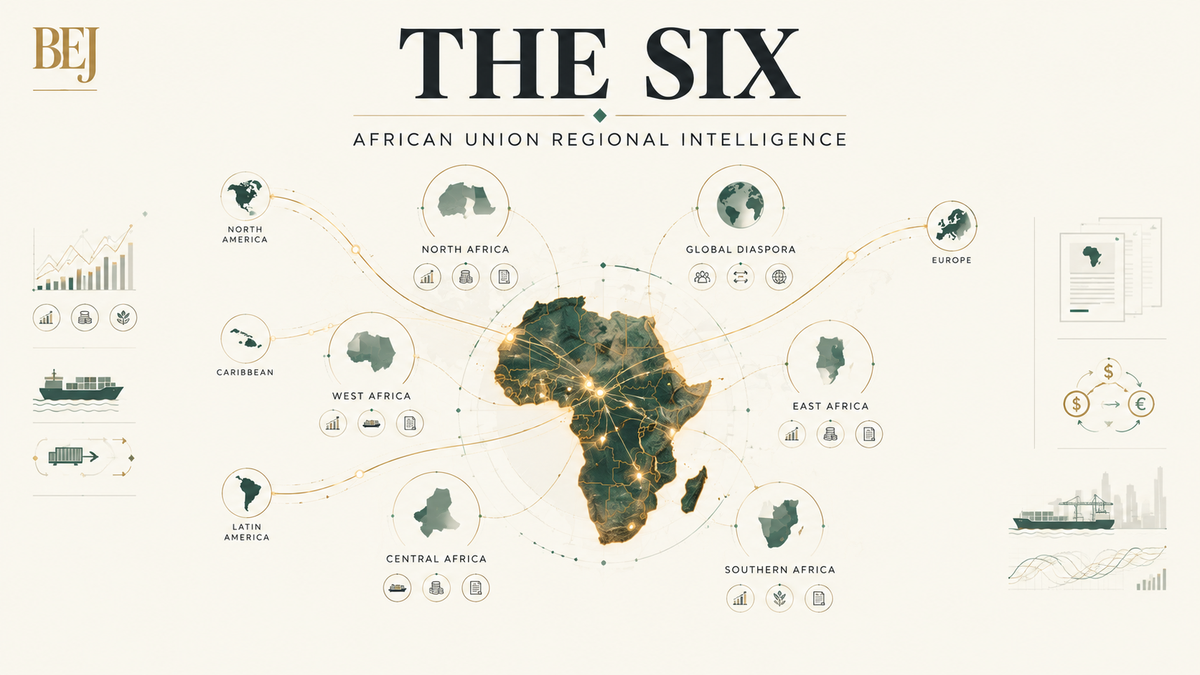
BEJ announced The Six on October 16 as a free public intelligence platform measuring the African Union’s five continental regions and the global African diaspora through a shared set of economic, market and policy indicators.
The platform’s premise reflects the Journal’s broader editorial approach: Black and African business activity should be understood across markets without treating those markets as interchangeable.
A shared framework gives readers a starting point for comparison. The next step is understanding the institutions, policies and commercial conditions behind each market’s figures.
Learn more about West African Citizenship policies from The Six on YouTube
10. BEJ Outlined Its AI and Enterprise Intelligence Roadmap
Our October 20 announcement detailed the expansion of BEJ’s technology infrastructure through relationships with Amazon Web Services and ElevenLabs. The development work encompasses cloud computing, AI-powered audio, business intelligence and institutional and enterprise-level APIs.
The distinction is important: the announcement describes infrastructure and products under development, not a claim that every proposed enterprise capability is already commercially available.
The direction is toward structured delivery of the Journal’s information resources beyond the website, connecting journalism, macroeconomic analysis, audio and data products for professional users.
11. Source Desk Opened a New Channel Into the Newsroom
On October 27, BEJ introduced Source Desk, an expert registry and reporting-request platform connecting qualified professionals with the newsroom. Executives, investors, economists, researchers, policymakers and founders can register to contribute knowledge, evidence and informed perspectives to reporting in development.
Source Desk and The Global Sourcing Desk have different roles. Source Desk supports journalism by connecting reporters with relevant expertise; The Global Sourcing Desk is part of the Journal’s commercial-intelligence publication offering.
For professionals with direct operating experience or specialized research, Source Desk provides a structured route to contribute before a story is published.
Learn more and sign up as a source on The Source Desk
Publications and Research: From the Screen to the Shelf
Black Executive Journal — The Magazine
October’s publication developments included the introduction of the first issue of Black Executive Journal — The Magazine, extending the Journal into print. The inaugural issue’s introduction highlights ownership, global business, media control and the capital behind growth.
The magazine is positioned for deeper reading and long-term reference, with delivery available to more than 150 countries. Its broader coverage spans executive leadership, entrepreneurship, investment, technology, global markets and generational wealth.
The Journal’s research offering also includes the BEJ Global Sourcing Report and BEJ Global Opportunities Report, bringing sourcing intelligence and international business research into the wider publication platform.
What October Means for Executives
October’s coverage returns to one central idea: infrastructure is more than physical construction.
It includes the institutions that assess credit, the financing structures that support enterprises, the digital systems that connect workers and businesses, and the legal and organizational foundations that turn expertise into lasting companies. Those connections run from AfCRA and Nigeria’s financing pipeline to the World Bank’s digital strategy and the historical enterprises examined in Yesterday’s Architects.
For readers heading into November, three questions provide a practical lens:
Where is announced capital becoming accessible financing, executable projects or identifiable commercial work?
Which institutions and contractual structures determine who controls the resulting assets?
What information, expertise and organizational capacity will a business need to participate?
Those questions will continue to guide how The Black Executive Journal connects daily developments with the longer story of business, capital and ownership.
Black Executive Brief editors curate Pulse and Week Ahead briefings for Black executives and investors, focusing on capital, ownership, and infrastructure shaping opportunity across business, policy, and global markets.