Black Executive Journal Launches The Six, a New Intelligence Platform for Africa and Its Global Diaspora
The free public intelligence platform measures the African Union’s five continental regions and the global African diaspora side by side—connecting markets, macroeconomic health, trade, policy, mobility, reparations and daily journalism.
One Continent. One Diaspora. Six Regions of Intelligence.
Black Executive Journal announces the launch of The Six, a free public intelligence platform built to measure the African Union’s five continental regions and the global African diaspora through a shared set of economic, market and policy indicators.
The African Union organizes its 55 member states into five regions: Northern, Western, Central, Eastern and Southern Africa. It also recognizes the African diaspora as an integral part of the continent’s development and the building of the Union.
The Six turns that framework into a unified intelligence experience, placing the five continental regions and Region 6—the global African diaspora—side by side.
Designed for investors, executives, economists, trade strategists, policymakers, researchers and diaspora organizations, the platform brings together regional dashboards, country profiles, public-market signals, macroeconomic indicators, policy records and downloadable data.
It addresses a persistent gap: continental datasets often end at Africa’s coastline, while diaspora economies remain embedded in the statistics of their host countries.
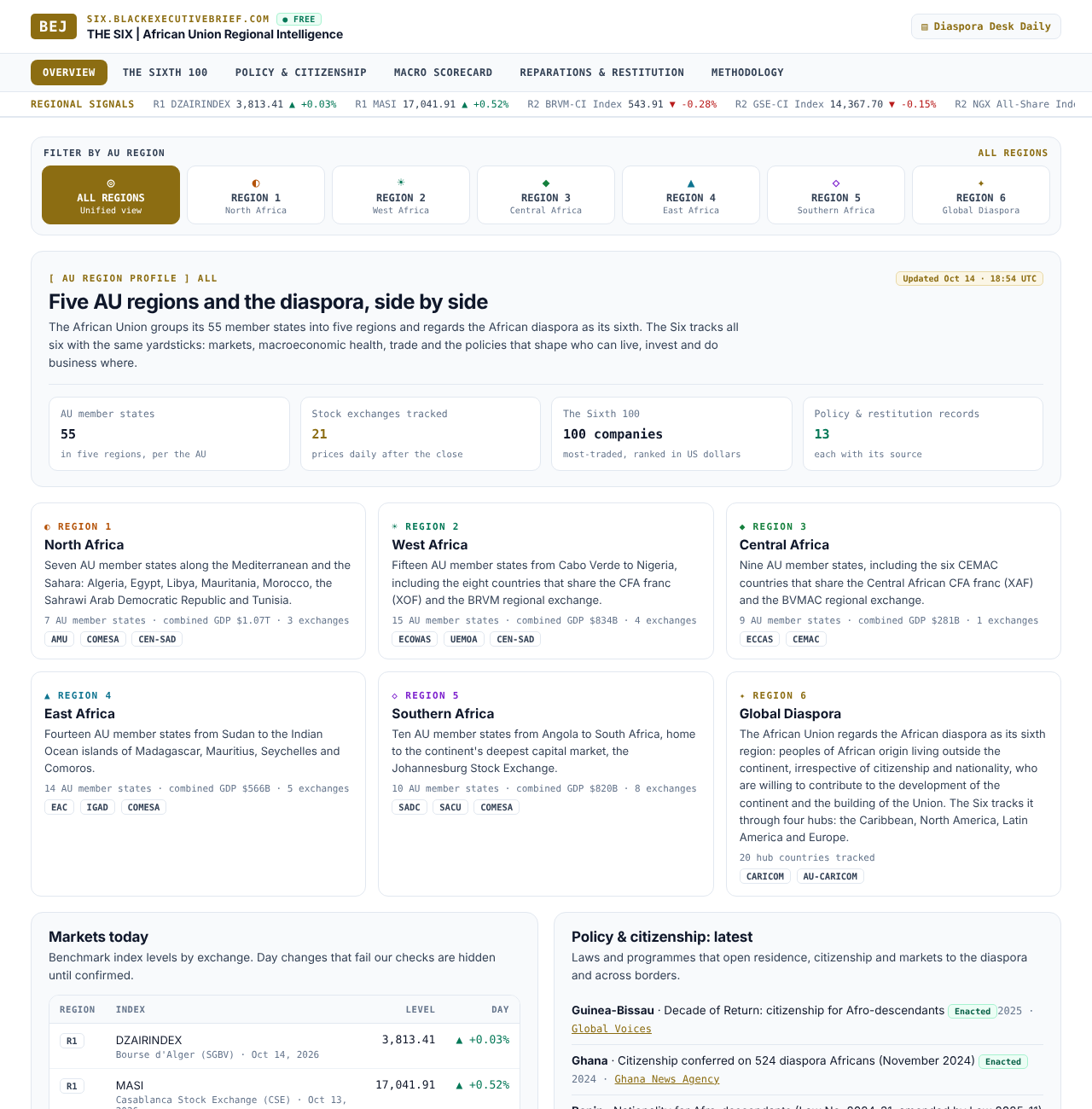
The Six provides a unified view of five African Union regions and the global African diaspora, with regional market, economic and policy intelligence.
From the overview, readers can move between all six regions while retaining the same basic framework. The platform currently covers 55 AU member states, 21 African stock exchanges, The Sixth 100 most-traded companies and a growing collection of sourced policy and restitution records.
Regional Intelligence at a Glance
The Six begins with a regional view designed to show the continent and its diaspora as parts of one economic system. Each AU region has a dedicated profile combining its member states, aggregate economic position, exchanges, regional blocs, market signals and policy developments.
The overview also brings together benchmark stock-index levels, currencies, commodities, trade measures, upcoming elections and the latest citizenship and mobility developments.
Regional filters allow users to move from the unified view to North, West, Central, East or Southern Africa, or directly to the Global Diaspora.
Every displayed figure identifies its source and reporting period. This gives readers the context needed to distinguish a current market price from a monthly indicator, an annual observation or a forward economic projection.
Markets and The Sixth 100
The Six tracks benchmark signals across 21 African stock exchanges, including index levels, daily movements and seven-session trends. Market pages are organized by AU region so users can compare activity without losing the local exchange and currency context.
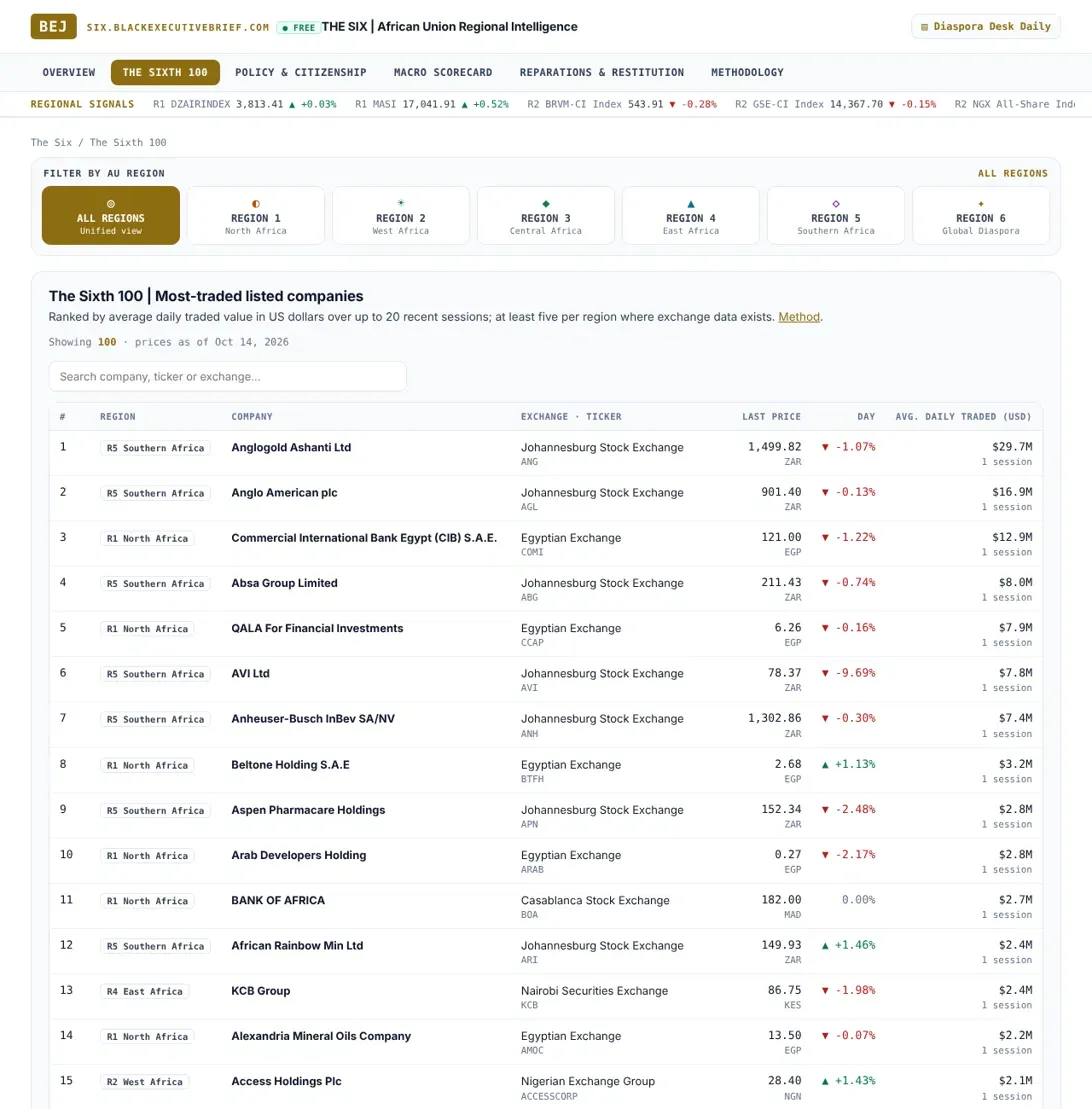
At the center of the public-markets experience is The Sixth 100, a ranking of the 100 most actively traded companies on the African exchanges covered by the platform.
Companies are ranked by average daily traded value in U.S. dollars over as many as 20 recent sessions, with at least five companies included from each AU region where exchange data is available.
The Sixth 100 measures liquidity—not market capitalization, corporate quality or investment merit. Prices and volumes come from exchange sessions and are converted into U.S. dollars using the relevant daily reference rate.
The platform’s regional-signals bar and markets tables make it possible to scan exchange performance quickly, while regional and country pages provide the wider economic context behind those movements.
The Sixth 100 ranks actively traded African-listed companies by average daily traded value in U.S. dollars, while regional market tables retain exchange-level context.
A Continental Macro Scorecard
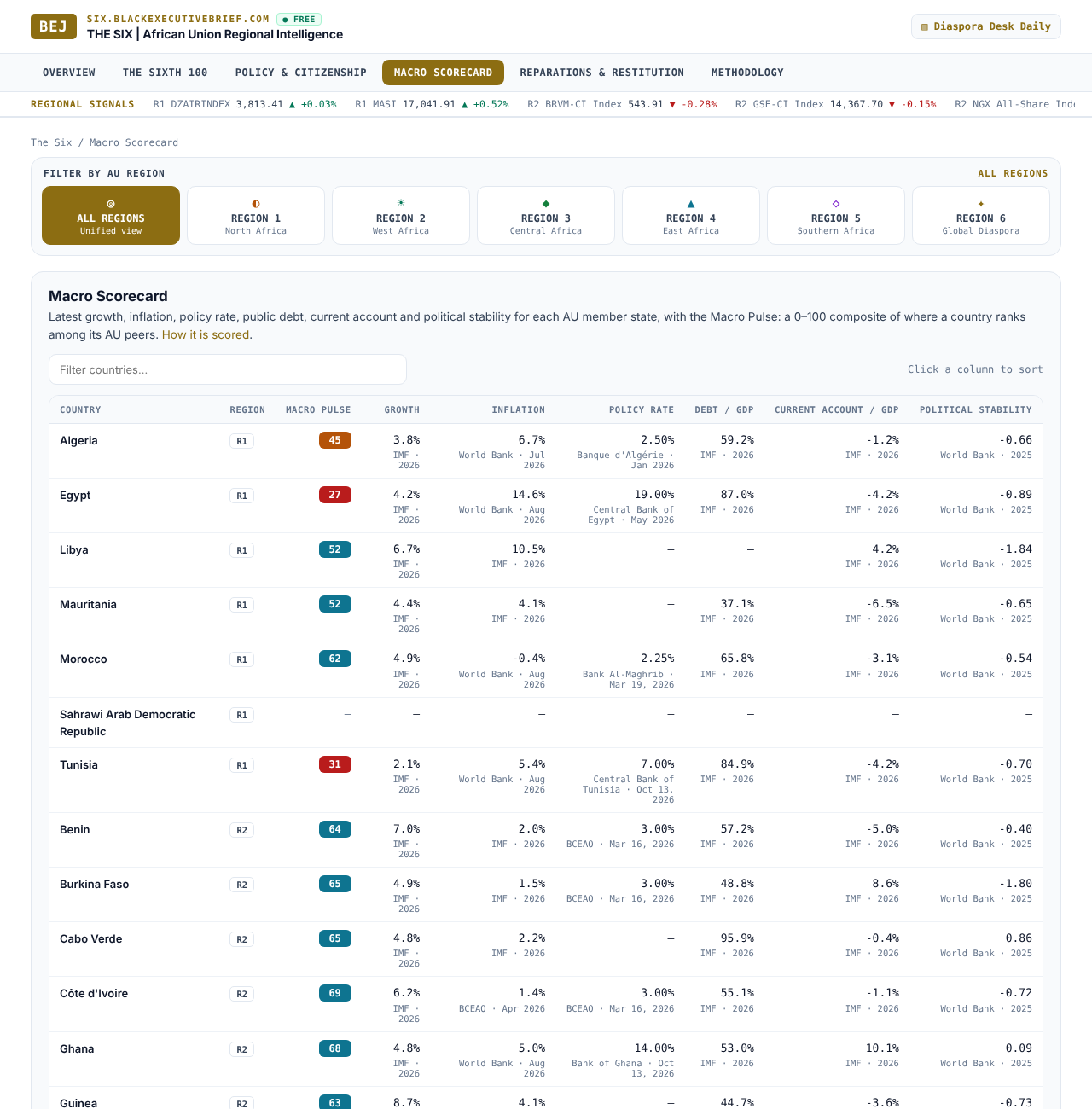
The Macro Scorecard presents the latest available growth, inflation, policy-rate, public-debt, current-account and political-stability figures for AU member states.
It also introduces the Macro Pulse, a 0–100 composite showing where a country ranks among its AU peers.
The Macro Scorecard places comparable economic indicators and the Macro Pulse across African Union member states.
The Macro Pulse is calculated from five measures: real GDP growth, inflation, public debt as a share of GDP, the current-account balance as a share of GDP and political stability.
It is a relative snapshot rather than a sovereign credit rating, and a score is shown only when enough underlying measures are available.
Each cell preserves the source and period for the underlying figure. The scorecard can be filtered and sorted, allowing users to compare individual measures or use the composite as an entry point for deeper country research.
Dedicated country profiles extend this analysis with indicators covering trade, foreign investment, remittances, currencies and other economic conditions. This creates a direct path from the continental comparison to the country-level data behind it.
Measuring the Sixth Region
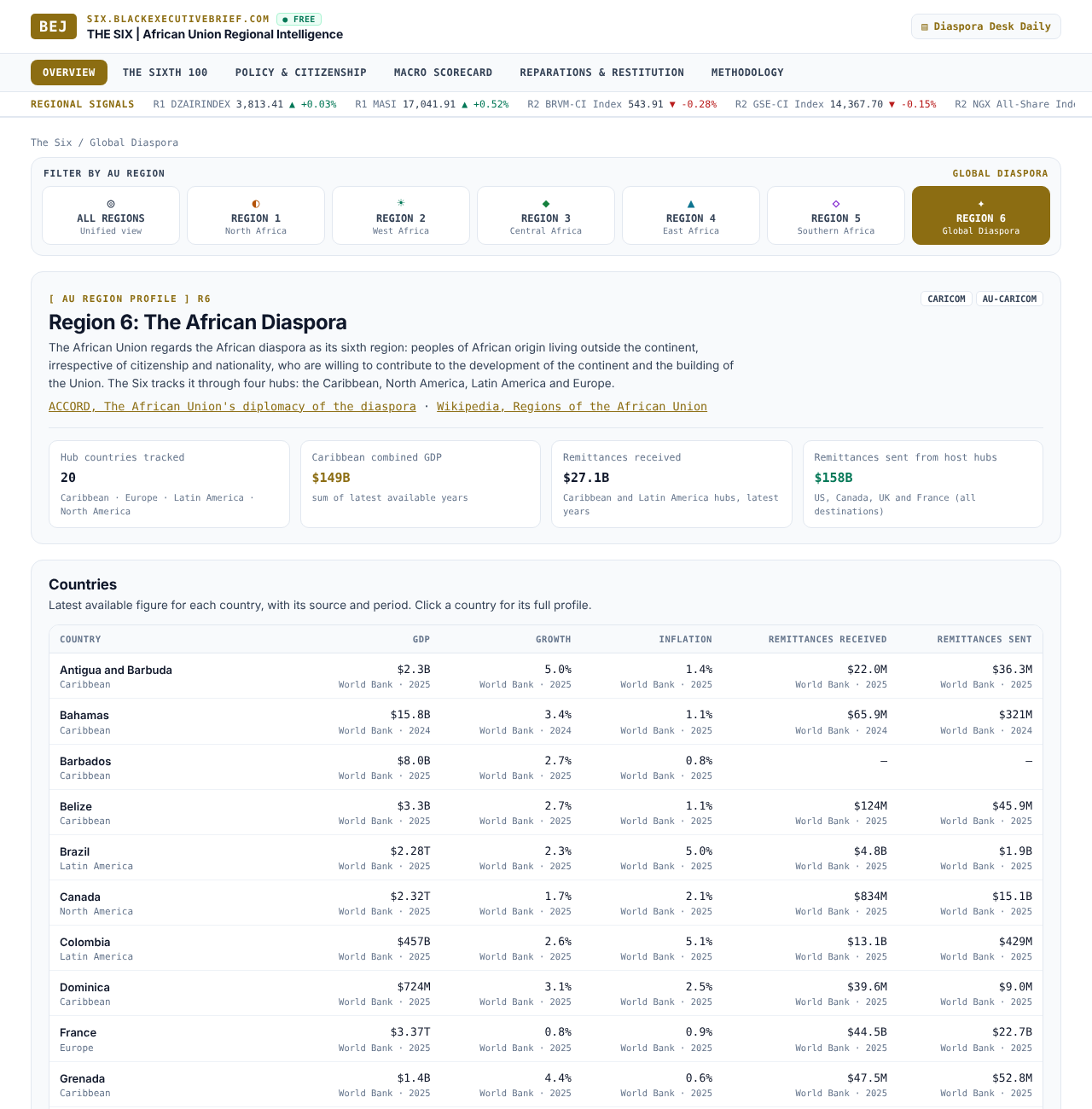
Region 6 gives the global African diaspora a defined place within the same intelligence system. The Six tracks the diaspora through four hubs—the Caribbean, North America, Latin America and Europe—and applies comparable economic measures across 20 hub countries.
The Global Diaspora dashboard organizes Region 6 through Caribbean, North American, Latin American and European hubs, with sourced economic and remittance data.
The regional dashboard brings together diaspora-country GDP, growth, inflation and remittance flows.
Users can select an individual country for a fuller profile; The Bahamas page, for example, identifies the country as part of the Caribbean hub within Region 6 and provides economic, market and policy indicators with sources and dates.
The BEJ Diaspora Equity Index adds a dedicated market signal for Region 6. It consists of a 60% allocation to U.S.-listed Black-owned and Black-led companies and a 40% allocation to diaspora- and Africa-access funds, equal-weighted within each group and rebalanced daily.
The index creates a visible public-market signal for a region that does not have a single exchange of its own.
It is an informational benchmark—not a fund, recommendation or investment product.
Policy, Citizenship and Mobility
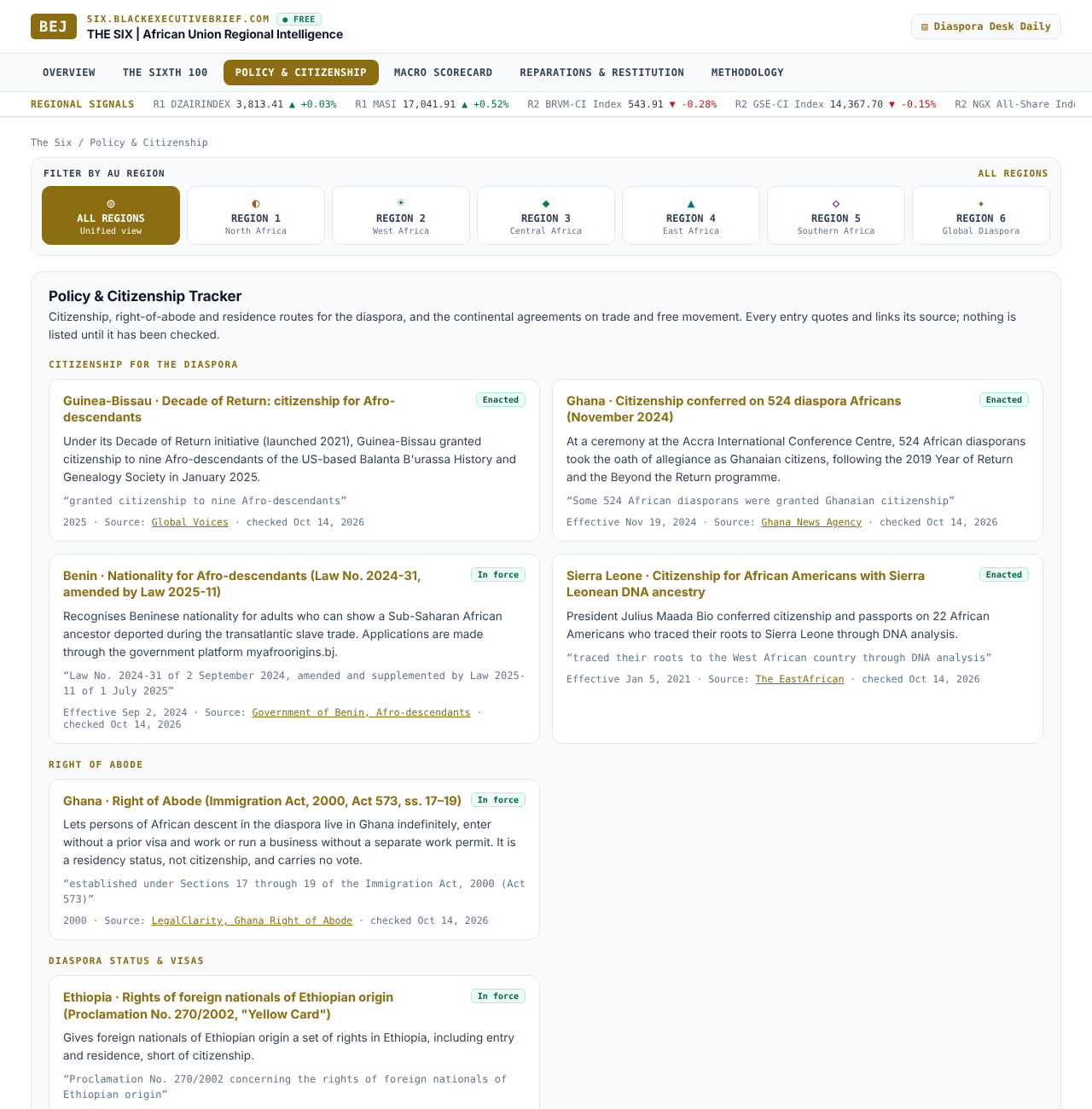
The Policy & Citizenship Tracker follows the laws and programs shaping how members of the diaspora can return, reside, obtain status, invest and conduct business, alongside continental agreements governing trade and free movement.
The Policy & Citizenship Tracker brings verified citizenship, right-of-abode, residence, free-movement and trade-integration measures into one view.
The tracker covers citizenship pathways for the diaspora, right-of-abode provisions, diaspora status and visa programs, free-movement agreements, and African Continental Free Trade Area integration.
Every entry quotes and links its source, and no item is listed until it has been checked.
Current records include measures involving Benin, Ethiopia, Ghana, Guinea-Bissau and Sierra Leone, as well as the AU Protocol on Free Movement of Persons and the AfCFTA framework. Each item displays its status, effective date, source and most recent verification date.
This structure makes the tracker more than a list of announcements. It distinguishes enacted measures from proposals, citizenship from residency, and national programs from continent-wide agreements.
Reparations and Restitution
The Reparations & Restitution Monitor tracks formal reparations frameworks, the return of cultural property, and developments involving debt and climate justice. It brings the AU and CARICOM agendas into the same intelligence environment as markets, macroeconomic conditions and diaspora policy.
The monitor includes the African Union’s reparations agenda, the Accra Proclamation on Reparations, the CARICOM Ten-Point Plan for Reparatory Justice and documented cultural-property returns. Each record identifies its status and links readers to its source.
By including reparations and restitution alongside economic intelligence, The Six recognizes that the relationship between Africa and its diaspora is shaped not only by current capital flows, but also by unresolved questions of ownership, extraction, cultural property and historical redress.
Intelligence Inside BEJ Stories
The Six is not limited to a standalone destination. Its data also appears directly inside relevant Black Executive Journal journalism through BEJ Intelligence · The Six cards.
These embedded cards provide an immediate economic snapshot of the country or region covered in an article. They identify the country’s AU region or diaspora hub, display the latest available indicators with their sources and periods, and link readers to the complete profile on The Six.
In Black Executive Journal’s report on The Bahamas recording its first fiscal surplus since independence, the embedded intelligence card identifies The Bahamas as part of Region 6: the African diaspora (Caribbean). It presents the latest reported GDP, real GDP growth, inflation and remittances alongside their sources, then links to the full Bahamas profile on The Six.
The integration connects journalism with structured intelligence at the point where readers need context. A news development can lead directly to the country, market and policy data behind it without separating the story from the evidence.
Transparent by Design
The Six is built around visible sourcing, dated observations and a published methodology.
Its sources include African stock exchanges and central banks, the IMF, World Bank, UNCTAD and specialist institutions, while Black Executive Journal conducts the research underlying its policy, citizenship, reparations and restitution records.
Data updates according to the rhythm of the original source.
Index levels update hourly during African trading hours on weekdays, stock prices update after the close, exchange rates update every four hours, policy rates are checked daily, and country indicators update as their publishers release them; site pages refresh every ten minutes.
The platform also applies publication controls.
A daily index move above 5% is withheld unless it can be confirmed against The Six’s previous close; stale indicators and commodity prices are removed according to published freshness thresholds; and when sources disagree, the most recent reporting period takes precedence.
Key datasets are available as CSV or JSON for independent analysis.
The Policy & Citizenship Tracker is Black Executive Journal research published under a Creative Commons Attribution 4.0 license, while third-party market and macroeconomic figures remain subject to the terms of their credited providers.
Built for Decisions
The Six gives each audience a practical place to begin:
Investors and market professionals can follow regional index signals, exchange activity and The Sixth 100.
Executives and trade strategists can examine country conditions, regional blocs, AfCFTA measures and cross-border policy.
Economists and analysts can compare macroeconomic indicators and download structured datasets.
Policymakers and diaspora organizations can track citizenship, mobility, remittances, reparations and restitution.
Researchers and journalists can follow every figure and policy record to its credited source.
The Six sits alongside Diaspora Desk Daily, Black Executive Journal’s live business and capital news service. Together, they connect continuous reporting with structured intelligence across Africa, the Caribbean and the global Black diaspora.
By placing all six regions within a shared framework, The Six provides a new way to see African and diaspora economic power: not as disconnected markets and communities, but as parts of a wider system shaped by capital, trade, policy, movement and history.
The Six provides public information and regional intelligence. It is not a fund, credit rating or investment-advisory service, and nothing published on the platform constitutes investment advice.
Black Executive Brief editors curate Pulse and Week Ahead briefings for Black executives and investors, focusing on capital, ownership, and infrastructure shaping opportunity across business, policy, and global markets.