Yoco Secures $100 Million Credit Facility From Victory Park Capital To Expand Merchant Lending
Yoco secured a $100 million credit facility from Victory Park Capital to fund Yoco Capital cash advances for more of its 200,000 South African merchants. The Black Executive Journal — Daily Edition
South African payments company Yoco has secured a $100 million credit facility from Victory Park Capital, a US firm specialising in private credit and asset-backed finance, to fund its Yoco Capital merchant cash advances (Yoco — Nov 9, 2026).
Yoco has distributed more than R6.5 billion in working capital to over 40,000 independent businesses since 2018 through partner credit providers. The new facility gives it direct control of that funding at scale for the first time (Yoco — Nov 9, 2026).
South Africa's small-business financing gap is about R350 billion, and small businesses receive 13% of bank lending against 51% for large corporations, according to figures Yoco cites from the 2025 Finfind and African Bank report (Yoco — Nov 9, 2026).
The Bank of Uganda held its Central Bank Rate at 12%, widened the policy band to ±3 percentage points from ±2, and raised its 12-month headline inflation forecast to 7.5–8.0% (Bank of Uganda — Nov 9, 2026).
Uganda's headline inflation rose to 5.8% in October from 4.6%, and the central bank cut its FY2026/27 growth estimate to 5.5–6.0% (Bank of Uganda — Nov 9, 2026).
The British Business Bank agreed an ENABLE Guarantee supporting up to £200 million of NatWest funding for small-business lender Capital on Tap (British Business Bank — Nov 9, 2026).
The EBRD is backing a solar plant with battery storage in Benban, Egypt, with a $63.5 million package (EBRD — Nov 9, 2026).
SOUTH AFRICA — Yoco Secures $100 Million Credit Facility From Victory Park Capital
Yoco, the South African payments and point-of-sale company, has secured a $100 million credit facility from Victory Park Capital (VPC), a global investment firm that specialises in private credit and asset-backed finance.
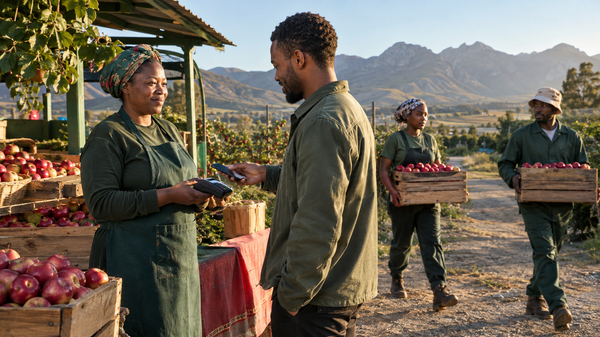
The facility funds Yoco Capital, the cash-advance product built into the Yoco App, so Yoco can offer advances to more of the over 200,000 businesses that use its card machines and online payment tools (Yoco — Nov 9, 2026).
The product itself does not change.
Merchants do not apply. Qualifying businesses see an offer in the app, pre-approved on their live in-person and online sales, with no collateral required. Advances range from R2,000 to R1.5 million.
Merchants repay through small deductions from their daily takings, not a fixed monthly instalment. Yoco says merchants use the money to hire staff, stock up before busy season, upgrade equipment or open a new branch (Yoco — Nov 9, 2026).
What changes is who holds the loans. Since 2018 Yoco has worked with dedicated SME credit providers, distributing more than R6.5 billion in working capital to over 40,000 independent businesses. This facility gives Yoco direct control of that funding for the first time at scale.
The company will keep working with outside funders where that suits a particular product or market. "Owning pricing and risk on our own book means what we learn goes straight back into a better offer," the company said.
CEO Carsten Holtkemeyer said: "Financing was the one layer we didn't fully control. This facility changes that" (Yoco — Nov 9, 2026).
Yoco is betting that its data predicts repayment.
"Every swipe, tap and sale on Yoco builds a live picture of how your business performs, something a bank statement or credit bureau can't show," the company said, adding that the same data lets it design funding for specific types of business.
It frames the market using the 2025 Finfind and African Bank SA MSME Access to Finance Report: a small-business financing gap of about R350 billion, with small businesses receiving 13% of bank lending compared with 51% for large corporations (Yoco — Nov 9, 2026).
Why It Matters
African payments companies are becoming lenders, funded by foreign private credit rather than by local banks. A $100 million asset-backed line is a balance-sheet test: Yoco now carries the credit risk, earns the full margin and has to show default rates that will support larger facilities.
This is the model other payments platforms across the continent are likely to follow. Independent South African retailers, salons, restaurants and service firms have a working-capital source that does not ask for collateral or a credit bureau file.
Founders building payments businesses elsewhere in Africa or the diaspora should note the sequence: build transaction volume first, prove repayment through partner lenders, then raise asset-backed debt to bring the loan book in-house.
UGANDA — Bank Of Uganda Holds Central Bank Rate At 12 Percent And Widens Policy Band
The Bank of Uganda's Monetary Policy Committee met on 9 November and kept the Central Bank Rate (CBR) at 12%.
It widened the CBR band to ±3 percentage points from ±2, and set the margins on the CBR for the rediscount rate and bank rate at 4 and 5 percentage points (Bank of Uganda — Nov 9, 2026).
The Bank said inflation has edged up and several upside risks have materialised since October. Headline inflation rose to 5.8% in October from 4.6% in September, driven largely by energy and weather shocks. Core inflation rose to 4.4% from 3.7%, a sign that price increases are spreading.
Average inflation over the 12 months to October stayed moderate, at 3.6% for headline and 3.3% for core, below the 5% medium-term target (Bank of Uganda — Nov 9, 2026).
The Bank raised its forecasts.
It now projects core inflation of 6.0–6.5% and headline inflation of 7.5–8.0% over the next 12 months. It cited higher international oil prices linked to the Middle East conflict, a worsening current-account deficit that could weaken the shilling, and slowing portfolio inflows.
It said risks are "skewed to the upside" and warned that if advanced-economy central banks keep policy tight or tighten further, the shilling could come under more pressure (Bank of Uganda — Nov 9, 2026).
Growth is slowing.
The Bank's high-frequency indicators put growth at about 5.3% in the quarter to September, against 6.8% reported by the national statistics office for the quarter to June. The Bank cut its FY2026/27 growth estimate to 5.5–6.0% from 6.0–6.5%.
It still expects growth of about 8% a year over the next five years, supported by private investment, exports, the oil sector and the government's Tenfold Growth Strategy (Bank of Uganda — Nov 9, 2026).
Why It Matters
A wider band gives the Bank more room to let interbank rates move without changing the policy rate.
Treasurers should expect more volatility in shilling funding costs even though the headline rate is unchanged. A forecast of 7.5–8.0% headline inflation, well above the 5% target, means rate cuts are unlikely soon. Importers and exporters in the East African corridor should hedge shilling exposure now.
Diaspora holders of Ugandan government paper should weigh rising yields against the depreciation risk the Bank itself has flagged.
UNITED KINGDOM — British Business Bank Backs Up To £200 Million Of NatWest Funding For Capital On Tap
The British Business Bank has agreed an ENABLE Guarantee transaction supporting up to £200 million of funding from NatWest to specialist lender Capital on Tap. The funding will support Capital on Tap's lending to smaller businesses that need flexible working capital (British Business Bank — Nov 9, 2026).
Capital on Tap provides working capital through a business credit card designed for small business owners. More than 300,000 small business customers have used its cards for more than £40 billion of transactions in the UK since it started in 2012 (Capital on Tap — Nov 9, 2026).
The ENABLE Guarantees programme is designed to increase lending to smaller businesses. Participating lenders receive a government-backed guarantee on defined portfolios of debt finance in return for a fee. The programme is open to UK banks, UK branches of foreign banks, asset finance providers, asset-based finance providers and certain other categories of lender (Capital on Tap — Nov 9, 2026).
Why It Matters
This deal and Yoco's follow the same pattern: a big funder (here a high-street bank backed by a government guarantee) provides wholesale money, and a technology lender originates the small-business loans.
Black-owned UK businesses, which have historically had lower approval rates from mainstream lenders, can benefit from that wholesale funding without applying to a bank directly. UK diaspora founders building lending platforms should look at the ENABLE programme as a way to bring in bank funding.
EGYPT — EBRD Backs Benban Solar Plant With Battery Storage In $63.5 Million Package
The European Bank for Reconstruction and Development (EBRD) is helping to finance a solar power plant with a battery energy storage system in Benban, near Aswan. The $63.5 million package supports Egypt's aim of increasing renewable electricity capacity and making its grid more reliable (EBRD — Nov 9, 2026).
The EBRD said support from the Climate Investment Funds (CIF) and Canada helps fund the battery storage and speed up decarbonisation (EBRD — Nov 9, 2026).
The same day, the EBRD said the European Union is adding €150 million in EFSD+ guarantees under its Global Gateway initiative to expand two existing EBRD programmes for digital and green investment (EBRD — Nov 9, 2026).
Battery storage is what makes solar power usable after sunset.
Development banks pairing storage with solar points to more solar-plus-storage tenders across Africa. Engineering, procurement and construction firms, battery integrators and operations-and-maintenance contractors should track EBRD project pipelines in Egypt and its newer West African markets.
The Benin trade-finance line is directly relevant to importers who need confirmed letters of credit.
Disclaimer: This report is for informational purposes only and does not constitute financial advice. Consult a licensed advisor before making investment decisions.
Black Executive Brief editors curate Pulse and Week Ahead briefings for Black executives and investors, focusing on capital, ownership, and infrastructure shaping opportunity across business, policy, and global markets.