September 2026 Roundup: The Black Executive Journal’s Essential Reads, Market Signals and New Reports
The Black Executive Journal’s September 2026 roundup: essential coverage on rates, AI, African markets, digital finance, global capital opportunities and sourcing intelligence.
September confirmed that executive decision-making now requires a more connected view of the global economy.
Monetary policy, access to capital, AI-driven infrastructure demand, trade flows, African market developments, sourcing strategy, and institutional ownership are no longer separate conversations—they are operating realities that shape growth, investment, and competitive position.
Throughout the month, The Black Executive Journal tracked the decisions, deals, policy shifts, industrial developments, and historical operating models that matter to executives building across the United States, Africa, and the wider diaspora economy.
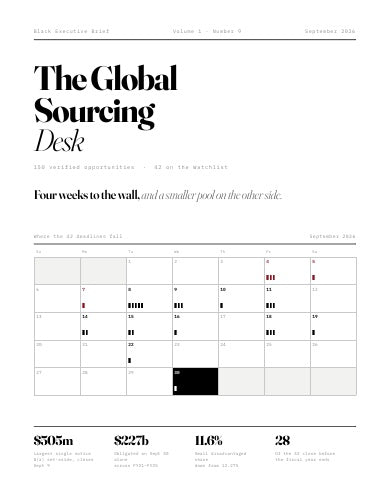
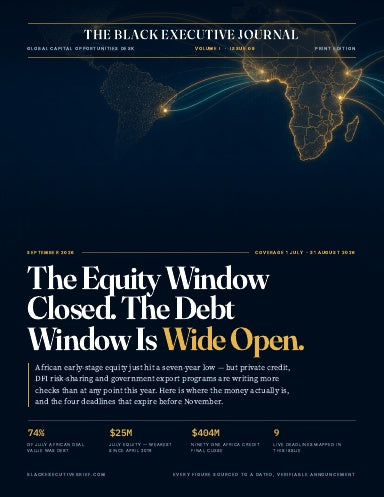
We also released two new research publications—The Global Sourcing Desk: September 2026 Edition and Global Capital Opportunities: September 2026—to help readers translate market awareness into commercial action.
This month’s essential coverage spans the Federal Reserve’s return to rate hikes, the infrastructure consequences of the AI economy, African capital-market activity, cross-border trade and sourcing signals, and the Black business builders whose strategies still offer practical lessons in ownership and scale.
1. The Federal Reserve Restarted Its Rate-Hiking Cycle
The Federal Reserve raised the federal funds target range to 3.75%–4.00% in a unanimous 12–0 vote, marking its first rate increase since July 2023.
“The Fed has re-opened the hiking cycle and told the market to expect another quarter-point higher, with a real chance of two, by year-end.” — The Black Executive Journal
For executives, the decision is not simply a macroeconomic headline.
It affects the cost of working capital, refinancing assumptions, acquisition economics, commercial real-estate exposure, consumer demand, startup funding conditions, and the hurdle rate applied to new investments.
The operational message is straightforward: companies should continue planning for a capital environment in which debt remains expensive, liquidity matters, and growth investments must meet a higher standard of return.
AI’s economic impact expanded beyond software, models, workforce automation, and market valuations in September.
“To fully recognize the benefits of AI, we must pair optimism with caution and be cognizant of valid concerns AI may pose for privacy, bias, workers, fraud, cybersecurity, and intellectual property rights.” — Lisa D. Cook, Governor, Federal Reserve
Federal Reserve Governor Lisa Cook said AI investment is adding to inflationary pressure and delaying a return to the Fed’s 2% inflation target. She pointed to the resource-intensive nature of large-scale AI expansion, including electricity and water costs that were about 5% higher over the prior year.
This reframes the AI conversation for executives.
The growth of AI is also a story about utility capacity, grid investment, data-center development, water access, land, construction, cooling infrastructure, and the suppliers that make compute possible.
3. Stablecoin Regulation Moved Toward Institutional Adoption
The Federal Reserve Board advanced two proposals under the GENIUS Act that would establish a more formal regulatory framework for Board-supervised payment-stablecoin issuers.
The proposals call for issuers to meet reserve, capital, risk-management, custody, governance, and application requirements.
Permissible reserve assets would include short-term Treasury bills, a structure that brings stablecoin operations closer to the risk, liquidity, and compliance expectations associated with traditional financial institutions.
For banks, fintechs, payments companies, treasury teams, asset managers, and investors, the question is increasingly less about whether stablecoins will become institutional financial infrastructure.
It is about which organizations will have the compliance maturity, balance-sheet capacity, and trust to participate.
4. The U.S. Current-Account Deficit Widened Sharply
The U.S. current-account deficit rose 15.7% in the second quarter, widening by $33.4 billion to $246.0 billion, or 3.0% of gross domestic product, as the goods deficit expanded.
💡
$246.0 billion: The U.S. current-account deficit in Q2 2026, up $33.4 billion—or 15.7%—from the prior quarter.
For business leaders and investors, the data offers an important read on the relationship among trade, domestic consumption, global supply chains, currency dynamics, and foreign capital.
It is especially relevant for companies exposed to imports, exports, cross-border manufacturing, international demand, or global financing conditions.
5. Nigeria Delivered Its Largest Rate Cut on Record
The Central Bank of Nigeria cut its Monetary Policy Rate by 350 basis points to 23%, the largest single reduction in the institution’s history. The move followed a decline in headline inflation to 15.39% in August.
The scale of the decision puts Nigeria at the center of the global monetary-policy conversation.
For operators, investors, exporters, and firms considering expansion in West Africa, the important issues now include the availability and pricing of credit, the direction of consumer demand, foreign-exchange conditions, inflation persistence, and the effect of lower rates on investment activity.
While Nigeria delivered a historic easing move, South Africa’s Reserve Bank raised its repo rate by 25 basis points to 7.25% in a unanimous Monetary Policy Committee decision after August consumer inflation rose to 4.4%.
The contrast matters.
Africa is not a single policy environment, and executives operating across borders need country-specific assumptions for financing, price strategy, consumer purchasing power, currency exposure, and project economics.
7. Tokenized Settlement Took a Step Forward in Europe
The European Central Bank activated Pontes, a distributed-ledger bridge connecting distributed-ledger technology platforms to TARGET Services for tokenized wholesale settlement in central-bank money.
While this may read as a technical financial-services development, its long-term relevance is material. Wholesale settlement systems influence how capital moves between institutions, how securities and assets are tokenized, and how financial-market infrastructure evolves.
Executives in banking, payments, fintech, digital assets, asset management, and institutional technology should follow the practical deployment of these systems—not merely the headlines around tokenization.
8. African Energy, Infrastructure and Digital Connectivity Remained Investable Themes
September’s coverage reinforced the growing connection between infrastructure investment and long-term economic positioning across Africa.
The African Development Bank approved a $5.1 billion Global Energy and Fertilizer Crisis Response Framework, comprising $4.1 billion in additional lending and $960 million from the African Development Fund.
That puts funding behind energy access, fertilizer availability, agricultural resilience, logistics, food security, and related infrastructure needs.
💡
$5.1 billion: The new Global Energy and Fertilizer Crisis Response Framework, including $4.1 billion in additional AfDB lending and $960 million from the African Development Fund.
The U.S. Development Finance Corporation also committed up to $155 million in equity investment to WIOCC for African digital infrastructure, underscoring the commercial and strategic importance of the continent’s connectivity layer.
For suppliers, developers, advisers, financiers, logistics providers, and technology companies, these are not distant development stories.
They are signals of future procurement, partnership, project-finance, and market-entry activity.
9. Dangote Refinery Put African Industrial Capital on Display
Dangote Refinery opened an initial public offering on the Nigerian Exchange, offering 4.1 billion shares at ₦525 per share in a proposed ₦2.15 trillion raise.
“The Dangote IPO is the largest naira-denominated retail equity subscription in years.” — The Black Executive Journal
The transaction is a consequential test of domestic capital formation, the financing of large industrial assets, energy security, and African public-market depth. It also illustrates a wider point: African business opportunity is not limited to early-stage technology.
Strategic industrial infrastructure, manufacturing, processing, energy, logistics, and local-market platforms remain central to the continent’s next investment cycle.
10. The Month’s Essential Forward-Looking Briefing
September closed with an important calendar for the fourth quarter: JOLTS data, the third estimate of U.S. second-quarter GDP, personal-income and PCE inflation data, and the September employment report.
These releases matter because they shape the path of rates, hiring, household spending, market sentiment, and corporate planning.
In a rate-sensitive environment, executives should treat the monthly data cycle as a planning input—not simply a financial-news event.
11. Yesterday’s Architects Revisited a Black-Owned Industrial Logistics Platform
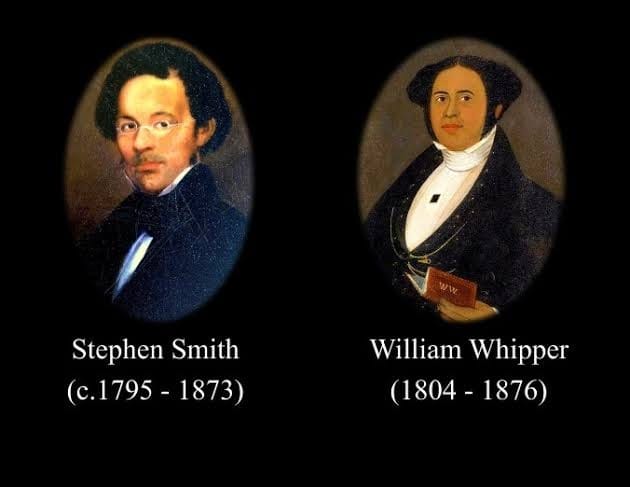
September also brought a new Yesterday’s Architects feature examining Stephen Smith and William Whipper, the nineteenth-century Black business operators who built a lumber, coal, rail-freight, real-estate, and financial-services platform under conditions designed to prevent Black wealth creation.
The article examines the operating lessons embedded in their story: learn an industry before owning it, use open infrastructure strategically, diversify when assets are exposed to political risk, preserve economic control even when formal titles are withheld, and turn income-producing assets into long-term institutions.
September’s coverage moved from current policy, capital markets, infrastructure, and global trade to the historical operating models that continue to inform how executives think about ownership, resilience, logistics, and institution-building.
Alongside this reporting, The Black Executive Journal released two new intelligence publications designed to turn market awareness into commercial action.
The Global Sourcing Desk: September 2026 Edition
The Global Sourcing Desk is the monthly procurement and supplier-intelligence publication for operators who need a stronger view of sourcing markets, supplier options, trade routes, product categories, purchasing dynamics, and global supply-chain opportunity.
The September edition is built for entrepreneurs, buyers, importers, distributors, agencies, procurement teams, and business leaders looking to turn international market research into a more actionable sourcing strategy.
Global Capital Opportunities is the monthly capital, projects, and opportunity-intelligence publication for executives looking beyond headlines to identify investable developments, institutional capital flows, project pipelines, infrastructure activity, cross-border deals, and emerging commercial openings.
The September edition is designed for investors, entrepreneurs, consultants, development-finance professionals, service providers, exporters, and organizations pursuing informed expansion across international markets.
New for B2B Advertisers: The 2026–2027 B2B Media Buyer’s Guide
The Black Executive Journal released its new 2026–2027 B2B Media Buyer’s Guide: Guaranteed Readers vs. Programmatic Ad Waste, a free 11-page resource for B2B marketers, media buyers, agencies, higher-education marketers, professional-services firms, and growth leaders evaluating how to reach executive audiences more efficiently through an advertising partnership with The Black Executive Journal.
Capital discipline remains non-negotiable. Higher policy rates and uneven global monetary conditions require more careful cash management, financing strategy, and investment selection.
AI investment is creating physical-economy opportunities. Compute demand increasingly depends on energy, construction, water, grids, real estate, cooling, hardware, and supply-chain capacity.
Global opportunities reward prepared operators. Africa’s infrastructure buildout, regional policy shifts, capital-market activity, and procurement needs create real openings—but only for companies equipped with credible market intelligence, partner access, and execution capacity.
What’s Next at The Black Executive Journal
October will mark an important next phase for The Black Executive Journal.
On October 12, 2026, we will publish the inaugural volume of Black Executive Journal™ — The Magazine, the new monthly print edition of The Black Executive Journal.
The magazine will expand our business-intelligence coverage through deeper reporting on Black executives, founders, investors, companies, capital, markets, entrepreneurship, and economic power across the United States, Africa, the Caribbean, and the wider African diaspora.
It will ship to readers in more than 150 countries worldwide.
Readers can also expect a growing set of announcements in the weeks ahead, including new technology partnerships, expanded media and distribution capabilities, and additional products designed to make The Black Executive Journal more useful to executives, operators, investors, advertisers, and institutions.
October will also bring the next editions of our recurring commercial-intelligence publications:
The Global Sourcing Desk: October 2026 Edition will continue to identify sourcing markets, supplier and procurement signals, trade pathways, and supply-chain opportunities for operators, buyers, importers, distributors, agencies, and procurement teams.
Global Capital Opportunities: October 2026 will continue to track investable projects, institutional capital activity, infrastructure developments, cross-border commercial openings, and opportunity signals for investors, founders, advisers, exporters, and growth-minded organizations.
Together, these releases reflect the direction of The Black Executive Journal: daily and weekly reporting for timely market intelligence; monthly research for actionable sourcing and capital opportunity; durable historical analysis through Yesterday’s Architects; and a global print magazine for the ideas, people, enterprises, and institutions shaping Black business leadership around the world.
October begins with a new volume, new intelligence, and a broader platform for the executives building what comes next.
The Black Executive Journal will continue to track the capital movements, policy decisions, ownership dynamics, market developments, and global opportunity signals that matter to Black executives, founders, investors, and business builders.
Black Executive Brief editors curate Pulse and Week Ahead briefings for Black executives and investors, focusing on capital, ownership, and infrastructure shaping opportunity across business, policy, and global markets.