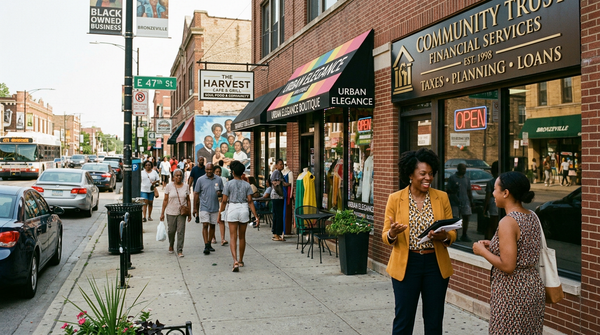
$2.1 Trillion and Counting. The Wealth Is Real. The Architecture to Hold It Is Not.
Black Americans generate $2.1 trillion in annual buying power and hold a median net worth of $44,100. Federal contracting access is narrowing under active policy pressure.
That is the 2026 estimate for Black American annual buying power — the total personal income after taxes flowing through Black households in the United States each year.
The 2025 baseline was $1.98 trillion. Essence confirmed in its own coverage that Black buying power would top $2 trillion in 2026. At this scale, Black American spending power is comparable to the GDP of major global economies.
It is not a demographic footnote.
It is an economic force of the first order.
The paradox that every serious analyst of Black economic life must confront is direct: a community generating $2.1 trillion in annual buying power holds $44,100 in median household net worth.
The Federal Reserve's Survey of Consumer Finances documents that Black household wealth has grown nearly 60% since 2020 — a real and meaningful gain that reflects rising home values, increased stock market participation, and entrepreneurial growth.
The NCRC's February 2026 Racial Wealth Snapshot confirms that figure while simultaneously documenting that Black households hold the equivalent of 15 cents for every dollar of white household wealth.
The gap between income flow and accumulated wealth is not a personal finance failure.
It is the output of a capital formation architecture that has been structurally misaligned for Black households for generations.
The global story is one of the largest free trade area in history beginning to price its own trade flows, the highest-return infrastructure market on earth seeking capital, and the diaspora policy infrastructure being actively built to receive investment at scale.
The median numbers make the structural argument precisely
The Federal Reserve's data documents that Black households hold a median of $5,000 in stock and financial assets — against $20,000 for white households.
The Census Bureau's 2021 data shows Black households collectively held only 4.7% of all U.S. household wealth. Black Americans represent 13.6% of the U.S. population and generate approximately 11% of national buying power — and hold less than 5% of the wealth.
Income participation is near parity.
Wealth accumulation is not.
Understanding why is the prerequisite for understanding how to change it.
How $2.1 Trillion Becomes $44,100
The consumption concentration pattern explains the gap
Black buying power is disproportionately absorbed by large national brands rather than recirculated within Black economic networks.
COMING UP...
How $2.1 Trillion Becomes $44,100
The portfolio composition data makes this tangible
The business ownership data adds the institutional dimension
Federal Contracting: The $755 Billion Market Being Restructured
The Global Connection That Reframes the Domestic Story
Nigeria's Central Bank is targeting $1 billion in monthly diaspora remittance inflows by the end of 2026