Wilson Ruffin Abbott stands as a towering figure in Canadian Black business history, transforming himself from a refugee fleeing racist violence in Alabama to one of Toronto’s wealthiest property owners and its first Black elected official.
His portfolio of 48 properties by 1871 represented a sophisticated understanding of property markets and investment strategy, achieved despite starting with no formal education.
Born around 1801 in Richmond, Virginia to a Scotch-Irish father and a free Black mother, Abbott’s life trajectory exemplifies the entrepreneurial determination that enabled Black Americans to build economic power in 19th-century Canada.
After leaving home at age 15 to work as a steward on Mississippi River steamers, Abbott married Ellen Toyer, a woman who had nursed him back to health after a serious injury involving falling cordwood.
The couple settled in Mobile, Alabama, where Abbott opened a successful general grocery store. However, in 1834, Mobile enacted discriminatory laws requiring all free Black people to provide bonds signed by two white men as a pledge of good behavior—part of Alabama’s increasingly hostile legal regime designed to control and ultimately expel free people of color from the state.
While Wilson built financial capital, Ellen built social capital through the Queen Victoria Benevolent Society and her church work...[their] partnership demonstrates that Black community advancement required both economic resources and social institutions, with Black women playing leadership roles often overlooked in historical accounts.
When Abbott received an anonymous warning that a white mob planned to pillage his store, he withdrew his life savings, put his wife and two children aboard a steamer to New Orleans, and slipped away alone on the night his store was attacked.
After a brief stay in New York, the Abbotts joined hundreds of other Black American families seeking greater freedom in Upper Canada, arriving in Toronto in late 1835.
Unable to read until his wife taught him, Abbott nonetheless possessed an extraordinary ability to perform complex mathematical calculations in his head—a skill that would serve him brilliantly in real estate.
The Abbott family’s multi-generational success illustrates how Black entrepreneurship created pathways for professional achievement.
After an unsuccessful venture in the tobacco business, Abbott became a property dealer and “increasingly made his mark in real estate.” By 1871, he owned an impressive portfolio of 42 houses, five vacant lots, and a warehouse, largely concentrated in Toronto, Hamilton, and Owen Sound.
Abbott’s influence extended far beyond business.
In 1837, he served in the militia protecting Toronto from rebels during the Upper Canada Rebellion, part of approximately 1,000 Black Canadians who volunteered to defend the British colonial government.
In 1838, he co-founded the Colored Wesleyan Methodist Church, serving as one of six organizers and helping purchase property for the congregation. Most significantly, in 1840, Abbott was elected to Toronto City Council from St. Patrick’s Ward—becoming the first Black person elected to municipal office in what would become Canada—carrying his ward by some 40 votes.
Abbott remained deeply committed to anti-slavery activism and community building. He was a prominent supporter of the Anti-Slavery Society of Canada and served on the Reform Central Committee established in 1859.
With his wealth, Abbott purchased freedom for numerous escaped slaves and employed his wife’s sister Mary as a well-paid housekeeper—a statement of dignity in an era when most Black women worked in domestic service for white families.
His wife Ellen was equally engaged in community leadership, helping organize the Queen Victoria Benevolent Society in 1840 to assist indigent Black women, and remaining active in the British Methodist Episcopal Church throughout her life.
The Abbott family became a pillar of Toronto’s Black community, raising four sons and five daughters. Their eldest son, Anderson Ruffin Abbott, would become the first Canadian-born Black physician licensed to practice medicine in 1861, later serving with distinction as a surgeon with the U.S. Colored Troops during the Civil War and attending President Abraham Lincoln on his deathbed.
Wilson Ruffin Abbott died in Toronto on November 6, 1876, at age 74 or 75, having lived to see his children achieve remarkable success.
Historical Significance to Black Business in America and Canada
Wilson Ruffin Abbott’s business achievements and civic leadership represent a critical chapter in North American Black entrepreneurship, demonstrating how 19th-century Black refugees used real estate investment as a pathway to wealth creation, political power, and community advancement.
Pioneer of Black Real Estate Entrepreneurship in Canada
Abbott emerged as one of Canada’s earliest and most successful Black real estate investors during a period when property ownership represented one of the few pathways to wealth accumulation available to Black people.
His story fits within a larger pattern of Black entrepreneurship in early Toronto, where by the 1850s, more than a dozen Black-owned businesses operated along King Street, including hardware stores, dry goods shops, barbershops, and the city’s first taxi service, established by formerly enslaved couple Thornton and Lucie Blackburn.
Abbott’s real estate portfolio placed him among Toronto’s wealthiest residents regardless of race, with holdings valued at substantial sums by 1871.
His success parallels that of other Black American entrepreneurs who used property investment to build wealth, such as Philadelphia’s Stephen Smith, whose real estate holdings were valued near $500,000 by the mid-19th century, making him the wealthiest Black man in the North.
Abbott’s achievements were particularly remarkable given that he arrived in Toronto as a refugee with limited resources and faced the additional barrier of illiteracy until his wife taught him to read.
Breaking Barriers in Political Representation
Abbott’s 1840 election to Toronto City Council represented a watershed moment in Canadian Black political history and highlighted crucial differences between Canadian and American attitudes toward Black citizenship in the 19th century.
Unlike in the United States, where the 1857 Dred Scott v. Sandford Supreme Court decision ruled that Black Americans could never be U.S. citizens, Canada allowed Black men who owned taxable property to vote and hold office following the abolition of slavery in the British Empire in 1834.
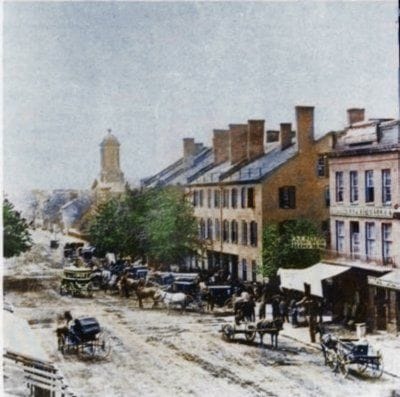
Abbott’s political success occurred within Toronto’s St. Patrick’s Ward, part of the larger St. John’s Ward district that became home to roughly half of Toronto’s approximately 1,000 Black residents by the 1850s and 1860s.
This concentration allowed Black voters to exercise collective political power in municipal elections. As historian Julie Roberts notes, while Canada offered Black refugees “only a very constrained freedom” with “unequal access to land and occupation” and “segregated schools, churches and voluntary associations,” the legal framework still provided protections unavailable in the United States.
Abbott’s election preceded by more than 50 years that of William Peyton Hubbard, who in 1894 became Toronto’s second Black city councilor and later served as acting mayor.
Abbott’s pioneering role demonstrated that Black political participation was possible in Canada decades before it would be in most American jurisdictions.
Economic Foundation for the Next Generation
Perhaps Abbott’s most enduring contribution was providing his children—particularly his son Anderson—with educational and economic opportunities that positioned them to break additional racial barriers.
Abbott sent Anderson to the Buxton Mission school near Chatham, one of the few racially integrated schools offering Black students an academic curriculum comparable to white students.
This educational investment, combined with the family’s financial resources, enabled Anderson to pursue medical training that made him the first Canadian-born Black physician.
The Abbott family’s multi-generational success illustrates how Black entrepreneurship created pathways for professional achievement.
Anderson’s medical career—including his service as surgeon-in-charge at Contraband Hospital (later Freedmen’s Hospital) in Washington, D.C., his appointment as coroner of Kent County in 1874 (the first Black person to hold that position), and his later role as surgeon-in-chief at Chicago’s Provident Hospital—all built upon the economic foundation his father established.
Key Contributions to Black Business in America
1. Demonstrating Real Estate as Wealth-Building Strategy
Abbott’s transformation from grocery store owner to real estate mogul pioneered a business model that countless Black entrepreneurs would follow.
His portfolio of 48 properties by 1871 represented a sophisticated understanding of property markets and investment strategy, achieved despite starting with no formal education.
Abbott “carefully studied property market trends, and noted which properties were most desirable,” much like later Black real estate pioneers such as Biddy Mason in Los Angeles, who used her midwifery earnings to acquire prime downtown Los Angeles real estate in the 1860s-1880s.
Real estate investment was particularly important for 19th-century Black entrepreneurs because it provided tangible assets that could not be easily seized, could appreciate over time, and could be passed to future generations—critical considerations for people fleeing slavery and racial violence.
Abbott’s success demonstrated that despite limited access to capital and pervasive racism, strategic real estate investment could generate substantial wealth for Black families.
2. Building Community Infrastructure and Institutions
Abbott understood that Black economic success required strong community institutions. His co-founding of the Colored Wesleyan Methodist Church in 1838 and his support for purchasing church property helped establish a cornerstone of Black community life in Toronto.
Churches served not just as places of worship, but as community centers, meeting spaces for political organizing, refuges for Underground Railroad passengers, and venues for mutual aid societies.
Abbott’s wife Ellen’s founding of the Queen Victoria Benevolent Society in 1840 represented one of Canada’s earliest Black women’s self-help organizations, providing assistance to sick and impoverished Black women at a time when government social services were virtually nonexistent.
These institutions created social safety nets and built social capital that enabled community members to weather economic hardships and resist discrimination.
Abbott’s active participation in the Anti-Slavery Society of Canada, founded at Toronto City Hall in February 1851, connected him to a transatlantic abolitionist network that included Frederick Douglass, who frequently lectured in Toronto’s Black churches.
This activism transformed Toronto into a crucial node in the Underground Railroad network and a beacon of hope for Black Americans seeking freedom.
3. Challenging Discriminatory Laws Through Political Engagement
Abbott’s political work extended beyond his city council service.
As a member of the Reform Central Committee and a vocal advocate for Black civil rights, he worked to oppose racist legislation and practices including segregated schools, discriminatory minstrel shows, and proposals to restrict Black immigration to Canada.
Black community leaders in St. John’s Ward “repeatedly pressed City Council and the colonial legislature to oppose public displays of bigotry” and legislative proposals harmful to Black residents.
Abbott’s political engagement came during a critical period when American policies were becoming increasingly hostile to Black people. The Fugitive Slave Act of 1850 allowed bounty hunters to recapture escaped slaves anywhere in the United States and required all law enforcement to cooperate, leading to widespread kidnapping of free Black people.
Abbott’s Toronto provided refuge from this terror, with Canadian authorities prosecuting American bounty hunters who crossed into Canada to kidnap Black people.
4. Serving as Economic Anchor for Refugee Settlement
Abbott used his wealth to assist newly arrived refugees from American slavery, purchasing freedom for fugitive slaves and helping them establish themselves in Canada.
This economic support was crucial for a population that typically arrived “destitute and without any assets” and had to “work as labourers for others until they could save up enough money to buy their own farms.”
Abbott’s properties in St. John’s Ward provided housing opportunities for Black residents in an area that became Toronto’s first multicultural neighborhood.
As one account notes, “Wilson Ruffin Abbott, a former enslaved man, became one of Toronto’s wealthiest Black property owners in the 19th century. He provided economic opportunities for Black settlers in St. John’s Ward.”
His business success also provided crucial inspiration to other Black entrepreneurs. In the 1840s and 1850s, Toronto saw Black-owned contractors, shoemakers, tavern operators, and merchants establish themselves, creating an ecosystem of Black business that demonstrated economic possibilities to newly arrived refugees.
Legacy and What Readers Should Remember
Key Takeaways:
- Resilience in the Face of Violence: Abbott’s forced flight from Mobile, Alabama represents the brutal reality that prompted the Great Migration of Black Americans to Canada in the 1830s-1860s.Alabama’s 1834 laws requiring free Black people to leave the state within 12 months of emancipation, with re-enslavement as punishment for non-compliance, exemplified the legal terrorism that made economic success impossible for free Black people in the American South.Abbott’s ability to rebuild his life and achieve even greater success in Toronto demonstrates the extraordinary determination of Black refugees.
- Political Participation as Foundation for Civil Rights: Abbott’s 1840 election proved that when Black people had legal rights and could vote, they could achieve political representation and influence policy.His election occurred in the same decade when many American states were actively stripping Black people of voting rights and citizenship claims. The contrast highlights how legal frameworks either enable or prevent Black political and economic advancement.
- Education as Intergenerational Investment: The Abbott family’s story illustrates how first-generation wealth creates opportunities for subsequent generations to achieve professional success.Wilson’s real estate profits funded Anderson’s medical education, which in turn enabled Anderson to break barriers in medicine and public health.This pattern of entrepreneurial wealth funding professional achievement became a crucial pathway for Black advancement throughout North American history.
- Gender Partnership in Community Building: While Wilson built financial capital, Ellen built social capital through the Queen Victoria Benevolent Society and her church work.Their partnership demonstrates that Black community advancement required both economic resources and social institutions, with Black women playing leadership roles often overlooked in historical accounts.
- Toronto’s Black Community as Historical Beacon: St. John’s Ward, where the Abbott family lived and worked, represents a crucial but now largely erased chapter of Canadian history.The area, now covered by Nathan Phillips Square and surrounding institutional buildings, was once home to a thriving Black community with its own churches, businesses, debating societies, and mutual aid organizations.Recognizing this history challenges narratives that position racial diversity as a recent Canadian phenomenon.
- Comparative North American Context: Abbott’s success occurred during a period when free Black people in the United States faced escalating legal restrictions, violence, and exclusion from citizenship rights.His ability to vote, hold office, own property without restriction, and live without constant fear of kidnapping by bounty hunters demonstrates that while Canadian society was far from perfect, its legal framework provided protections crucial for Black economic and political development.
- Continuing Barriers: Despite Abbott’s exceptional success, he benefited from advantages not available to most Black Canadians—including his location in Toronto rather than more hostile rural areas, his mathematical abilities, his marriage to a literate woman, and perhaps his mixed-race heritage.Most Black Canadians in the 19th century faced “segregated schools, churches and voluntary associations” and “unequal access to land and occupation.” Abbott’s story is important precisely because it shows what was possible when barriers were partially lowered, highlighting how discrimination constrained the vast majority of Black people.
- Modern Parallels: Today, Black Canadians represent 4.3% of the population but only 2.4% of business owners, facing ongoing barriers to capital access, mentorship, and business networks.Abbott’s 19th-century challenges—difficulty accessing capital, discrimination, and the need to build separate institutions—echo in modern experiences, suggesting that structural barriers to Black entrepreneurship persist across centuries.
Wilson Ruffin Abbott’s journey from refugee to real estate mogul and elected official embodies the resilience, business acumen, and political courage that Black entrepreneurs have brought to North American economic and civic life since the 19th century.
His legacy challenges us to recognize that Black business success—when legal frameworks permit it and communities support it—can break barriers, build wealth, and create opportunities across generations.
The parallels between Abbott’s 1830s challenges and those facing Black entrepreneurs today underscore the persistence of structural barriers while also highlighting the enduring power of entrepreneurship as a tool for Black economic empowerment and community advancement.
Resources for Further Study
Primary and Archival Sources:
Biographical Resources:
Historical Context:
Underground Railroad and Anti-Slavery Movement:
Upper Canada Rebellion and Black Militia:
Black Entrepreneurship History:
Contemporary Black Entrepreneurship:
Alabama Free People of Color Context:
Related Community Histories:
Museums and Archives: