Why Africa's Critical Minerals Are the Leverage the Diaspora Has Been Waiting For
Black Executive Journal | Global Markets & Capital | Week 5 of 6 — "Building the 21st Century" Series

– 7 min read


Black Executive Journal | Global Markets & Capital | Week 5 of 6 — "Building the 21st Century" Series
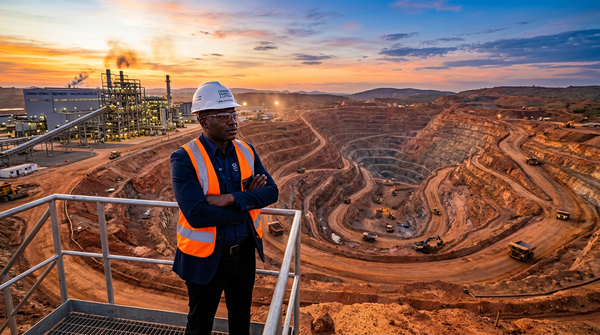
The Democratic Republic of Congo supplies 70% of the world's cobalt.
For decades, that cobalt left the country in raw form — dug from the earth, loaded onto ships, and processed into battery-grade material in China, Japan, South Korea, and Europe.
The DRC received the commodity price. Everyone downstream received the value-added margin.
Then the DRC began processing cobalt domestically.
The country's cobalt export value went from $167 million to $6 billion.
That is a 36-times multiplier — not a future projection, but a realized outcome that already happened when one African nation decided its mineral wealth would stay in Africa long enough to generate industrial value.
At the 2025 BRICS summit in Rio de Janeiro, the heads of state representing nations that account for more than 40% of global GDP made a collective declaration: this model must become the continent-wide standard.
South African President Cyril Ramaphosa stated it in plain language:
"These minerals must not be exported in raw form only. There should be beneficiation and value addition on the continent."
The era of Africa as raw material supplier to the world's manufacturers is officially, institutionally, and irreversibly closing.
5x — the projected increase in global demand for critical minerals by 2035 compared to 2023 levels.
Solar panels, wind turbines, EV batteries, energy storage systems, and advanced semiconductors all require dramatically higher mineral inputs than the fossil fuel infrastructure they are replacing.
That demand is not flexible.
It must be met.
And the supply is overwhelmingly in Africa.
Africa's critical mineral endowment is not a marginal factor in the global energy transition.