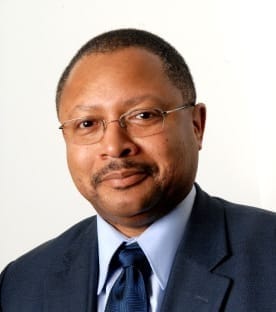
Today's Builders · The Black Executive Journal™ Detroit, Michigan · Real Estate & Economic Development · GWJ Group · Founded 2014
At a Glance
— Born in Detroit; attended Cooley High School before earning a bachelor's degree in human resource development from Oakland University and a master's degree in business management from Central Michigan University
— Worked in personnel and human resources with the U.S. Navy; held professional-level positions at Detroit Edison; served as adjunct faculty at Lawrence Technological University; then a 27-year career at DTE Energy rising to Director of Customer Marketing — during which DTE's Energy Economic Development Department gained national recognition and received Site Selection Magazine's Utility Economic Development Award
— Joined the Detroit Economic Growth Corporation in 2002 as a loaned executive from DTE Energy; elected President and CEO in April 2002; ran the organization for twelve years through two mayoral administrations, the city's Chapter 9 bankruptcy, and the deepest auto industry collapse since the Great Depression
— In twelve years at DEGC, led the completion of 436 projects resulting in 10,000 housing units, 39,000 jobs, and $10 billion in investment for the city of Detroit — figures entered into the official record of the Michigan State Senate upon his departure
— From 2006 to 2010, simultaneously served as Chief Development Officer for the City of Detroit, overseeing economic development, planning, building, and the Civic Center Department — running both roles concurrently during the city's most acute period of financial distress
— Deals negotiated on Jackson's watch: the $190 million restoration of the Book Cadillac Hotel into the Westin Book Cadillac; the relocation of Quicken Loans and Dan Gilbert to downtown Detroit; the consolidation of thousands of Blue Cross Blue Shield of Michigan jobs in the city; the deal that kept General Motors' world headquarters in Detroit; Whole Foods Market to Midtown; and Meijer's Gateway Marketplace — Detroit's largest shopping center investment in more than forty years
— Named "Detroiter of the Year" by Hour Detroit magazine in 2006; awarded "CEO of the Year" by Automation Alley in 2007; received the Revitalization of the City Award from Friends School in Detroit in 2009; named to Crain's Detroit Business "50 Names to Know: Real Estate" in 2016
— Founded GWJ Group LLC upon leaving DEGC in 2014; immediately retained by Olympia Development of Michigan as residential development consultant for District Detroit — the same sports and entertainment complex whose public-side deal he had negotiated from inside the DEGC
— Currently President and CEO of GWJ Group LLC; serves as Chairperson of the Greater Detroit Foreign Trade Zone; remains on the DEGC board in an emeritus capacity
Twenty-Seven Years Learning How Capital Moves Before He Ever Tried to Direct It
George Jackson did not walk into economic development.
He worked his way toward it across three decades, accumulating the specific technical knowledge that the work would require before he ever held a public title.
He began his career in personnel and human resources with the U.S. Navy, then held professional-level positions at Detroit Edison — the predecessor to DTE Energy — working across human resources, organizational planning and development, and power generation.
The progression was deliberate.
He was learning how large institutions make decisions, allocate resources, and respond to external pressure.
That knowledge, applied later to the work of moving private capital into a struggling city, would prove foundational.
He also served as adjunct faculty at Lawrence Technological University's School of Management — teaching while simultaneously building the practitioner experience that gave the instruction its credibility.
His 27-year career at DTE Energy culminated as Director of Customer Marketing.
The title is deceptive. What Jackson ran was the intersection of utility economics and corporate site selection — understanding what companies needed from an energy and infrastructure standpoint when making location decisions, and building the case for Michigan as that place.
Under his leadership, DTE's Energy Economic Development Department gained national recognition and received Site Selection Magazine's Utility Economic Development Award — the highest recognition in utility-based economic development.
He had spent nearly three decades learning what it took to bring investment to a region before he was asked to do that for Detroit itself.
The City Nobody Was Investing In Needed Someone Who Understood Why
Jackson moved from the private to the public sector first as a loaned executive from DTE Energy, then as full-time President and CEO of the Detroit Economic Growth Corporation.
He took the interim post in February 2002 and was elected President and CEO in April of that year.
The Detroit he inherited was not a city investors were lining up to enter.
The auto industry, which had sustained the regional economy for a century, was showing structural fractures that would nearly destroy it within a decade.
Downtown office towers were emptying.
The tax base was shrinking.
The riverfront — three miles of what should have been the city's most valuable land — was industrial, fenced, and inaccessible.
The Book Cadillac Hotel, one of the great addresses in the American Midwest, had been abandoned since 1984.
DEGC was a private nonprofit corporation devoted to supporting Detroit's economic development projects through technical, financial, negotiation, and development assistance to the city and private-sector business.
In practice, it was a deal-making infrastructure — a quasi-public body with enough technical capacity to structure complex transactions and enough institutional credibility to sit across the table from major corporations, developers, and government bodies simultaneously.
Jackson ran it for twelve years.
He ran it through the 2008 financial crisis, through the collapse of General Motors and Chrysler, through Detroit's 2013 Chapter 9 bankruptcy filing — the largest municipal bankruptcy in American history at the time — and through the recovery that followed.
He ran it while simultaneously serving as Chief Development Officer for the City itself from 2006 to 2010.
For four years he was the chief architect of Detroit's economic strategy while the city's finances were in acute distress.
The Deals That Kept Detroit in the Game
The deals Jackson's team negotiated saved the historic Book Cadillac Hotel and turned it into the Westin Book Cadillac; brought Quicken Loans and investor Dan Gilbert into Detroit; consolidated several thousand jobs at Blue Cross Blue Shield of Michigan; and kept General Motors' world headquarters in the city.
Each transaction represented a different kind of problem requiring a different kind of solution.
The Book Cadillac required an incentive stack — historic tax credits, brownfield financing, a developer willing to take construction risk in a market with no recent comparable transactions — assembled carefully enough that the math worked for Cleveland-based developer John Ferchill.
The building reopened in 2008 as the Westin Book Cadillac Detroit.
Quicken Loans required a competitive incentive package structured to make Detroit the rational financial decision against competing markets. Dan Gilbert's arrival and the subsequent decade of investment his companies poured into downtown Detroit reshaped the urban core in ways that extended far beyond any single transaction.
The DEGC negotiated the door open.
General Motors' headquarters was technically already in Detroit — the Renaissance Center on the riverfront. But headquarters can move, and in an era when corporations routinely relocated to lower-cost cities, the economic and symbolic weight of GM leaving would have been devastating.
Jackson's team negotiated the deal that kept them.
Jackson's team also led efforts to bring a Whole Foods Market to Midtown Detroit and a Meijer superstore to Gateway Marketplace — Detroit's largest shopping center investment in more than forty years.
These are not glamorous deals.
They are the transactions that determine whether a neighborhood functions — whether residents have access to groceries, whether a commercial corridor has anchor tenants, whether the smaller businesses that depend on foot traffic have the conditions to survive.
In twelve years, Jackson led DEGC through the completion of 436 projects resulting in 10,000 housing units, 39,000 jobs, and $10 billion in investment for the city.
What the Public Sector Taught Him That Private Practice Couldn't
The DEGC's structural position gave Jackson something no private developer had: the ability to operate across the entire transaction simultaneously.
He could work the public incentive authorities — the Downtown Development Authority, the Economic Development Corporation of the City of Detroit, the Tax Increment Finance Authority, the Detroit Brownfield Redevelopment Authority — while simultaneously negotiating with private developers and corporate site selectors.
He understood what each side needed and could structure deals that gave both sides a path to yes.
That is not a skill acquired quickly.
It is built through repetition — through transactions that stall, through incentive structures that don't pencil out on the first attempt, through corporate decisions that reverse after months of negotiation, through political dynamics that shift with each administration.
Jackson had twelve years of that practice inside an institution with both public mandate and private-sector operational discipline.
He also served simultaneously as Chief Development Officer for the City of Detroit from 2006 to 2010, overseeing economic development, planning, building, and the Civic Center Department.
The dual role — running the DEGC while serving as the city's internal development officer — gave him a view of the full system that few economic development practitioners ever achieve.
The Exit and What He Built With It
Jackson announced his plans to step down from DEGC and form a Detroit-based private consulting and development firm in January 2014. He was clear-eyed about the transition.
Mayor Mike Duggan had his own team and his own vision for how economic development would be organized under the new administration.
Jackson read it and moved.
His new firm was retained as residential development consultant for District Detroit — the $1.5 billion sports and entertainment district anchored by Little Caesars Arena, whose public-side deal Jackson had been closely involved in negotiating during his DEGC tenure.
His institutional knowledge of every assumption, every commitment, and every pressure point embedded in that transaction was precisely what made him valuable to the private side.
GWJ Group provides comprehensive development services from the pre-development phase through project completion, specializing in navigating the regulatory, political, and financial complexity required to bring a project to a successful conclusion.
What that description represents is forty years of accumulated knowledge about how Detroit's development system actually works — what it requires, where it stalls, and how to move it forward.
He currently serves as Chairperson of the Greater Detroit Foreign Trade Zone and remains on the DEGC board in an emeritus capacity.
Detroit's Recovery Is a Story About Transactions
The Detroit that exists in 2026 — the riverfront, the downtown residential density, the District Detroit, the Midtown corridor — was built deal by deal over decades by many people across many institutions. Jackson did not build it alone.
What he did was run the organization that held the deals together during the years when Detroit had the fewest reasons to attract them — through a financial crisis, through an auto industry collapse, through a municipal bankruptcy, across twelve consecutive years of grinding negotiation with corporations, developers, and government bodies that had every legitimate reason to invest somewhere else.
The 436 projects.
The 39,000 jobs.
The $10 billion.
Those are not marketing numbers.
They are what twelve years of closing deals in a city nobody was betting on actually produces.
He still lives in the Detroit area.
He still works in Detroit.
The work continues.
Detroit's revival is not a story about inspiration.
It is a story about transactions — specific negotiations, specific incentive structures, specific decisions by specific people to put capital into a city where capital had stopped flowing.
George W. Jackson Jr. was at the center of more of those transactions than anyone else during the years that mattered most.
The city he helped build is the evidence.
Sources
The following sources were used directly in the reporting of this profile. All factual claims in this piece are drawn from these documents.
Wikipedia — George W. Jackson (developer) Primary biographical reference; education, career timeline, awards, founding of Ventra Group https://en.wikipedia.org/wiki/George_W.Jackson(developer)
Detroit Regional Chamber — George Jackson biography Confirmed DTE Energy title (Director of Customer Marketing), 27-year tenure, Chief Development Officer role 2006–2010, DEGC mandate and structure, academic credentials https://www.detroitchamber.com/bios/george-jackson/
Michigan Chronicle — George Jackson Prepares for New Chapter in City's Transformation (March 2014) Career history prior to DTE, adjunct faculty at Lawrence Technological University, Navy and Detroit Edison background, Site Selection Magazine award confirmation Archived: https://web.archive.org/web/20180318182639/https://michronicleonline.com/2014/03/05/george-jackson-prepares-for-new-chapter-in-citys-transformation/
Detroit Free Press — Former city arena negotiators working for Ilitches (February 2016) GWJ Group / Ventra Group retained as residential development consultant for District Detroit https://www.freep.com/story/money/business/michigan/2016/02/12/former-city-arena-negotiators-working-ilitches/79062186/
Crain's Detroit Business — George Jackson's new firm named residential development consultant for District Detroit (December 2015) GWJ Group founding, District Detroit consulting mandate confirmed https://www.crainsdetroit.com/article/20151221/NEWS/151229980/george-jacksons-new-firm-named-residential-development-consultant
Crain's Detroit Business — 50 Names to Know in Real Estate: George Jackson (2016) Awards and recognition confirmed https://www.crainsdetroit.com/awards/george-jackson
MLive — George Jackson stepping down from Detroit Economic Growth Corporation helm (January 2014) Departure date and transition details confirmed http://www.mlive.com/business/detroit/index.ssf/2014/01/george_jackson_stepping_down_f.html
Today's Builders is a series by The Black Executive Journal profiling the founders, operators, investors, and executives shaping Black and African business right now — the dealmakers closing rounds, the operators building institutions, the strategists entering new markets and constructing lasting economic infrastructure across the diaspora economy in real time.