Today's Builders · The Black Executive Journal™ Washington, D.C. · Sustainable Infrastructure Finance · Founded SCA 2012
At a Glance
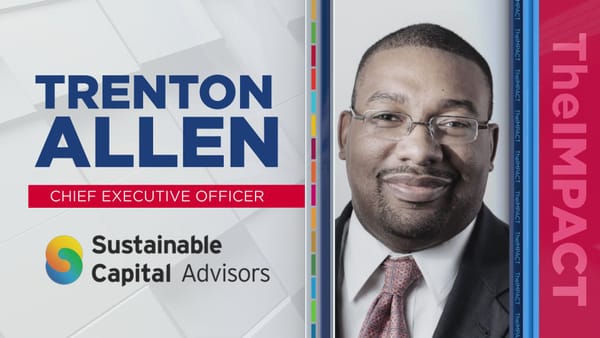
— Founder, CEO, and Managing Director of Sustainable Capital Advisors (SCA), a Black-owned financial advisory firm built from the ground up in Washington, D.C. in 2012 — now one of the most consequential firms operating at the intersection of green finance and environmental justice
— Participated in over $30 billion in financings across utility, energy, transportation, and public infrastructure — accumulated across more than twenty years in institutional banking before founding SCA
— Sole underwriter for one of the nation's first green bond issuances — the Delaware Sustainable Energy Utility's inaugural Energy Efficiency Revenue Bond — at a time when the domestic green bond market did not yet formally exist
— Previously financed more than $17 billion in tax-exempt and taxable bonds for municipal electric utilities at Citi; prior to that, led the Quantitative Strategies Group at Public Financial Management, the nation's leading financial advisory firm for state and local government
— Appointed by U.S. Secretary of Energy Jennifer Granholm to the Secretary of Energy Advisory Board in 2021, engaging on grid modernization and the infrastructure dimensions of the clean energy transition
— Selected by the U.S. Department of Energy in October 2024 — alongside RMI and Southface Institute — to lead equitable climate financing for the DOE's Energy Future Grants Program, providing specialized financing support across 40 participating project teams and $27 million in technical assistance
— Launched SIFAC — the Sustainable Infrastructure Finance Academy — in May 2024, a platform built specifically to give CDFIs, community lenders, and minority deposit institutions the tools to execute green lending transactions and compete for the EPA's $27 billion Greenhouse Gas Reduction Fund
— Advised the Justice Climate Fund, the BIPOC-led coalition formed to ensure that community financial institutions — not large commercial banks — captured a meaningful share of the largest federal climate appropriation in U.S. history
— Active in partnership with the Hive Fund for Climate and Gender Justice to advance clean energy projects across the South; AB in chemistry, Harvard University; boards: CleanEnergyWorks, Interstate Renewable Energy Council (IREC)
A Coal Plant in Springfield, and the Question It Left Behind
The deal was ordinary by early-2000s municipal finance standards. The city of Springfield, Illinois needed to replace an aging coal plant. Trenton Allen, then working infrastructure transactions at Citigroup, was on the financing.
Then the Sierra Club showed up.
The opposition wasn't fringe. It was organized, well-resourced, and — Allen concluded watching it unfold — correct. Coal's problem wasn't only political. The economics were deteriorating in ways the industry wasn't admitting and capital markets weren't yet pricing.
Allen read the signal clearly: the old energy economy was closing, and a new one was opening.
What nobody in institutional finance was asking was who would be on the right side of that opening — and who, absent deliberate intervention, would not.
That question was not abstract. Communities of color across the United States had spent generations living near landfills, refineries, and power plants — not by choice, but because they had no capital leverage to choose otherwise.
They carried the health consequences of the old energy economy and collected almost none of its economic returns.
The shift to clean energy, left to follow existing capital, would follow existing wealth. The households that had paid the most to live downwind of the old system would watch the new one get built for someone else.
Allen left that coal deal carrying a question he couldn't put down: how do you build the financial architecture that routes the capital of the energy transition toward the communities that need it most — on terms that actually build local wealth, not just reduce energy bills for people who can already afford them?
He spent the next decade constructing the answer.
What Twenty Years at the Desk Actually Bought Him
Before Allen founded anything, he learned how institutional money moves. That education came in two places, and neither of them was comfortable or quick.
He started at Public Financial Management — the country's largest financial advisory firm for state and local government — with no formal finance training.
He taught himself the work, gravitating toward the quantitative roles, building the financial models that determine whether a public infrastructure project can survive long enough to get financed.
He eventually ran PFM's Quantitative Strategies Group, training other analysts in the methodology he had learned by doing. Then came more than a decade at Citi, focused on municipal electric utilities and the emerging territory of sustainable infrastructure.
It was at Citi that Allen structured and sole-underwrote the Delaware Sustainable Energy Utility's inaugural Energy Efficiency Revenue Bond — a transaction that used municipal bond markets to finance energy efficiency at scale, at a moment when the label "green bond" was not yet standard American financial vocabulary.
The deal worked.
It got done.
And it pointed toward a market that would grow into one of the most active segments of global fixed income over the following decade.
He took note. He also took more than $17 billion in conventional municipal bond transactions to close during his time at Citi — the technical depth that later allowed him to walk into any room in climate finance and speak the language of the people who actually move capital.
In 2012, he founded SCA. Not a fund.
An advisory firm.
The distinction matters: Allen does not deploy capital directly.
He helps organizations structure the deals that attract capital — which is harder work, less visible, and more consequential for the communities that cannot afford to get the structure wrong.
"How do we utilize this moment to safeguard and protect this planet that we share — but also as an economic opportunity, particularly in communities where they have been part of economic and environmental injustice."
— Trenton Allen
The Organizations Closest to the Problem Had the Least Access to the Solution
The gap Allen identified was not a gap in intent. Federal climate programs, foundation grantmaking, and state green bank initiatives have expressed commitment to underserved communities for years. The gap was in execution capacity.
The organizations with the deepest roots in Black and Brown communities — CDFIs, community lenders, minority deposit institutions, Black-led nonprofits — are systematically disadvantaged in climate finance competition. They have the community relationships no Wall Street firm can replicate.
What they frequently lack is the regulatory roadmap, the financial model, the bond counsel, and the deal structuring experience required to execute a $10 million clean energy transaction through a federal program with two hundred pages of compliance requirements.
Without that capacity, the capital flows to the institutions already positioned to receive it — which are not, in most cases, the institutions closest to the communities with the greatest need.
Allen's work with Groundswell illustrates the model precisely.
The Washington D.C.-based community solar developer was trying to bring clean energy to low-income neighborhoods in a city where those households were paying disproportionately high utility bills.
SCA advised Groundswell on a financing structure that embedded a cross-subsidy directly into the deal: 75% of customers on the solar grid pay market rate, generating the economics that allow the remaining 25% to receive the energy at no cost.
The households that had historically paid the most for power got access to clean energy on the best terms.
That outcome required someone who understood both the social objective and the capital markets mechanics that could sustain it. It is not charity.
It is financial engineering — and it is the kind of work that does not happen without an advisor who has spent twenty years learning how deals actually close.
SIFAC: Building the Capacity the Market Was Missing
When the EPA announced the $27 billion Greenhouse Gas Reduction Fund in 2024 — the single largest federal climate investment in American history, explicitly designed for low-income and disadvantaged communities — Allen recognized both the historic opportunity and the structural problem it exposed.
The money was there.
The intent was stated.
The problem was that the organizations with the strongest community relationships were the least equipped to compete for it.
A CDFI entering the GGRF competition without a financial advisor, a compliance framework, and familiarity with federal grant structures was entering against institutions with entire departments devoted to exactly that work. Absent intervention, the most significant climate appropriation in U.S. history would flow, yet again, toward the institutions already positioned to receive capital.
Allen's response was SIFAC — the Sustainable Infrastructure Finance Academy.
Launched in May 2024, the platform gives community lenders the tools to execute green lending transactions: live office hours, one-on-one advisory sessions, geographic readiness assessments, financial models, and peer networks with other institutions working through the same challenges.
The subscription pricing was set deliberately for resource-constrained organizations. In September 2024, Allen opened free access to four core SIFAC offerings for the entire month — a direct subsidy to the institutions that most needed the platform and could least afford it.
"We designed every aspect of the SIFAC platform with one goal in mind," Allen said at launch: "to make it possible for community lenders to execute climate-focused transactions."
He did not frame it as access.
He framed it as execution — because a transaction that does not pencil out does not get built, regardless of how worthy the cause.
The Federal Selection That Confirmed a Twelve-Year Thesis
In October 2024, the U.S. Department of Energy selected three organizations to lead technical assistance for its Energy Future Grants Program: RMI, founded as the Rocky Mountain Institute; Southface Institute, a nonprofit with deep expertise in sustainable buildings across the Southeast; and Sustainable Capital Advisors.
SCA's specific mandate: serve as specialized lead in equitable climate financing for all 40 Phase 1 project teams, with $27 million in financial and technical assistance at stake across the program.
The selection placed Allen's twelve-year-old firm alongside institutions with decades of federal contracting history and significantly larger staffs. The DOE did not select SCA for representation.
It selected SCA because of a demonstrated track record in exactly the work the program required — structuring sustainable infrastructure deals for communities that mainstream finance had historically bypassed.
Allen has also served since 2021 on the Secretary of Energy Advisory Board, engaging directly on grid modernization — the infrastructure challenge that underlies the entire clean energy transition.
The communities last to receive reliable power from the old grid are at risk of being last again with the new one.
His presence at that advisory table is, in part, structural insurance against that outcome repeating.
When Washington Retreats, the Economics Don't
The political environment in 2026 is not the one SIFAC was built inside. Federal incentives for renewable energy face accelerated phaseouts under the current administration.
The Greenhouse Gas Reduction Fund — the very program that catalyzed SIFAC's creation — is now subject to funding freezes and administrative pressure.
Allen has navigated this before. He built SCA across multiple administrations, including the first Trump term, when federal climate resources contracted sharply. His position has been consistent across all of them: the underlying economics of clean energy do not reverse with a change in administration.
Solar is cheaper to build than coal.
Storage costs are falling.
AI-driven data centers are consuming power at a pace the existing grid was not built to supply — creating demand for new generation that no executive order can legislate away.
As recently as February 2026, Allen was writing about the M&A surge in U.S. renewables driven precisely by that data center demand: market forces pulling capital into clean energy independent of federal climate policy entirely.
What shifts when administrations change is not the economics. It is access. The community institutions that depend on federal frameworks to compete for capital are the ones most exposed when those frameworks are dismantled.
That is the constituency SIFAC was built to serve — and the reason the platform's relevance increases, not decreases, when federal programs retreat.
"We went from President Obama to President Trump and we still worked our tails off. In some respects, we would do more work partly because there would not be as many federal resources."
— Trenton Allen
Most recently, Allen announced a partnership with the Hive Fund for Climate and Gender Justice — a grantmaking collaborative focused on Texas, Louisiana, Georgia, and the Carolinas — to advance clean energy projects across the South, the region where the energy transition is accelerating fastest and where communities of color have the least capital leverage to shape it on their own terms.
The energy transition will produce the largest reallocation of infrastructure capital in a generation.
The question of who sits at that table — who structures the deals, who advises the lenders, who ensures that the communities with the most at stake have someone in the room who can actually close — is not settled.
Trenton Allen has spent twenty years making sure that question has at least one serious answer.
Sources
The following sources were used in the reporting of this profile. All factual claims are drawn from these documents.
Wikipedia — Trenton Allen Primary biographical reference; founding of SCA, Delaware green bond issuance, DOE Advisory Board appointment, board memberships, education https://en.wikipedia.org/wiki/Trenton_Allen
Sustainable Capital Advisors — About Us Company history, founding mission, timeline, practice areas, culture, confirmed SCA as minority-owned business https://sustainablecap.com/pages/about-us
Sustainable Capital Advisors — DOE Energy Future Grants Program Press Release (October 2024) Federal selection confirmed; SCA mandate across 40 project teams; RMI and Southface Institute co-selection; $27 million technical assistance figure confirmed https://sustainablecap.com/resources/sustainable-capital-advisors-to-lead-equitable-climate-financing-for-does-energy-future-grants-program
Sustainable Capital Advisors — SIFAC Launch Press Release (May 2024) SIFAC platform launch confirmed; mission statement quote sourced directly; subscription model and free access period confirmed https://sustainablecap.com/resources/climate-finance-advisory-sustainable-capital-advisors-launches-sustainable-infrastructure-finance-academy-in-response-to-27b-greenhouse-gas-reduction-fund-grant-awards
Black Wall Street Times — Meet the Black CEO Bringing Capital to Sustainable Infrastructure (March 2024) Springfield coal plant story sourced; Groundswell 75/25 financing structure confirmed; Justice Climate Fund advisory role confirmed; Obama-to-Trump quote sourced directly from Allen interview https://theblackwallsttimes.com/2024/03/22/meet-the-black-ceo-bringing-capital-to-sustainable-infrastructure/
U.S. Department of Energy — Secretary of Energy Advisory Board appointment (October 2021) Advisory Board appointment confirmed; Secretary Granholm announcement https://www.energy.gov/articles/secretary-energy-jennifer-m-granholm-announces-newly-appointed-members-secretary-energy
U.S. Department of Energy — Trenton Allen profile Advisory Board membership and role confirmed https://www.energy.gov/person/trenton-allen
Sustainable Capital Advisors — Data Centers M&A piece (February 2026) Most recent published work confirmed; AI data center demand and renewables M&A analysis verified as current SCA output https://sustainablecap.com/resources/data-cmpa-in-us-renewables-despite-white-house-pushback
Today's Builders is a series by The Black Executive Journal profiling the founders, operators, investors, and executives shaping Black and African business right now — the dealmakers closing rounds, the operators building institutions, the strategists entering new markets and constructing lasting economic infrastructure across the diaspora economy in real time.