Yesterday's Architects · The Black Executive Journal™ Lexington, Kentucky · 1848–1918 · Funeral Services, Publishing, Law & Political Advocacy
At a Glance
- Born enslaved on February 28, 1848, in Lexington, Kentucky, on a plantation on Newtown Pike owned by the Graves family — freed at age 16 in 1864
- Denied any formal education; taught himself to read and write while shining shoes and splitting his wages with his parents; took night classes when he could afford them
- Returned to the Graves plantation for three years after freedom because shoe shining didn't pay enough — then left permanently, built himself from scratch, and never went back
- Married Eliza "Belle" Mitchell Jackson in 1871 — a woman who had been the first Black teacher at Camp Nelson, Kentucky, and whom Jordan publicly called "the best investment he ever made"
- Built a career spanning five industries simultaneously: law, newspaper publishing, funeral services, federal employment, and political advocacy
- Founded Porter and Jackson in 1892 at 36 North Limestone Street — the first African American-owned undertaking and livery business in Lexington; later bought out his partner and ran it alone
- Served as the first superintendent of Greenwood Cemetery — Lexington's Black cemetery — giving the community sovereign control over its own dead
- Spoke before the Kentucky legislature in 1892 to oppose the Separate Coach Law — Kentucky's railway segregation statute — one of the only Black voices heard on the floor in opposition
- Served as a delegate-at-large to the Republican National Convention in both 1876 and 1892; actively campaigned for President McKinley in 1896; served as IRS collector for Kentucky's 7th district
- Secretary of the 1875 National Negro Convention in Nashville; member of the NNBL Executive Committee under Booker T. Washington in 1905–1906
- Only Black trustee on the Berea College board for 12 years; lay trustee for Wilberforce University; committee member for the establishment of the Normal School for Colored Persons — now Kentucky State University
- Chaired the committee that created Douglass Park — Lexington's park for Black residents — named for Frederick Douglass
- Died October 7, 1918, in Lexington; buried at Cove Haven Cemetery; his wife Belle lived until 1942, outlasting him by 24 years and continuing their shared work
He was sixteen years old and free for the first time in his life, and he could not read
Jordan Carlisle Jackson Jr. had been born into slavery in 1848 on the Graves family plantation on Newtown Pike outside Lexington, Kentucky. In 1864, with the Civil War reshaping the legal architecture of the nation, he was freed.
He took the only work available — shining shoes — and split his wages with his parents. He took night classes when he could afford the time. He taught himself to read and write in the margins of a life that left almost no margin for it.
When the shoe shining proved insufficient, he made the decision that takes a particular kind of person to make: he went back.
For three years after emancipation, Jackson returned to the Graves plantation — not because he had been forced to, not because he had been re-enslaved, but because the economics of freedom in post-Reconstruction Kentucky left him no viable alternative.
He worked.
He saved.
He learned.
Then he left the second time, and he did not go back.
What he built over the next five decades was not a single enterprise but a portfolio of overlapping commitments: a funeral home, a law practice, a newspaper, a political career, a federal appointment, a cemetery, a park, and a university.
He built all of it in a city where the legal and social infrastructure was being deliberately reconstructed to confine Black life to its narrowest possible expression.
He did it alongside a woman he called the best investment he ever made — and he meant it as the highest possible compliment, which says everything about how Jordan Jackson understood the relationship between love and strategy.
The Education He Gave Himself
The formal record of Jordan Jackson's self-education is sparse by necessity — men who teach themselves to read in the 1860s South do not leave syllabi.
What the record shows is the outcome: a man who, denied schooling in slavery, produced a body of written work across multiple newspapers, delivered speeches before the Kentucky legislature, practiced law, and served as secretary of a national convention — all on the foundation of knowledge he had assembled himself, at night, while working other jobs to survive.
Denied an education, he taught himself to read and write.
Mr. Jackson had a zeal for education and political activism.
This is how Lexington's historical marker — erected in 2018 at the corner of North Limestone and East Short Streets — describes him. The compression is appropriate.
The zeal and the self-education were the same thing: both were acts of will applied against a system that had been designed to make them impossible.
Jackson served as a member of the Executive Committee National Negro Business League in 1905–1906.
He had reached the national leadership table of the most important Black commercial organization in the country — the same table where Mont Howell of Atlanta sat — on the strength of a mind he had built from nothing. He was not the product of Atlanta University or Berea College.
He was the product of night classes and shoe-shine wages and three years on a plantation he had already been freed from, accumulating the capital and knowledge he needed to leave permanently.
He became one of Kentucky's strongest education advocates.
He was a Trustee at both Berea and Wilberforce colleges.
He served as the only Black trustee on Berea's board for twelve years.
He sat on the committee that established the Normal School for Colored Persons — the institution that became Kentucky State University.
The man who had been denied education spent his entire career building the infrastructure that would make its denial impossible for those who came after him.
The Business He Built: First Black Undertaker in Lexington
Jackson and his business partner William M. Porter were the first African American undertakers in Lexington.
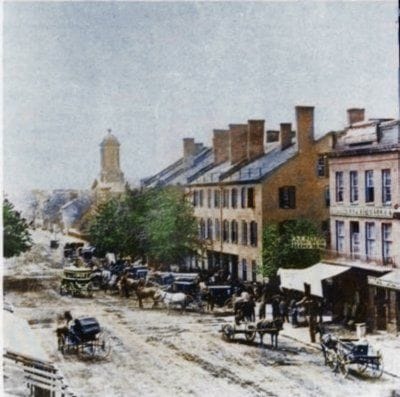
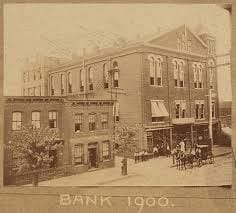
In 1892, they established Porter and Jackson at 36 North Limestone Street — a funeral and livery operation in the heart of the city's Black commercial district.
The funeral business is worth understanding in its full economic and cultural context. In the post-Reconstruction South, the Black funeral industry occupied a specific and essential position: it was one of the few professional services that white-owned businesses could not — and largely did not try to — provide to Black communities.
White funeral homes would not handle Black bodies.
Black families had no alternative.
The Black undertaker was therefore guaranteed a captive market in the most literal sense: every death in the Black community required his services, and no competitor from outside the community could take that business.
This structural reality made funeral homes one of the most reliable and durable sources of Black entrepreneurial wealth across the late 19th and early 20th centuries.
Jackson understood this. His entry into the business in 1892 — the same year he was fighting the Separate Coach Law in the Kentucky legislature — was not accidental. He was building a financial base at the same moment he was expending political capital in the legislature.
The business funded the advocacy.
The advocacy protected the community that sustained the business.
His business partner William M. Porter was eventually bought out by Jackson. He ran the operation alone, built its reputation, and held it through the remainder of his life.
He was simultaneously its owner and, as founding member and superintendent of Greenwood Cemetery, the steward of the land where his clients' families were buried. From death certificate to burial plot, Jordan Jackson controlled the infrastructure of how Black Lexington honored its dead.
This was not a small thing.
In a society that denied Black people dignified treatment in life, control over the rituals of death was one of the few forms of sovereignty available — and Jackson held it.
The Power Couple: Belle as Strategic Partner
Jordan was quoted as saying Belle "was the best investment he ever made, and that he owed much of his success to her."
Jordan Jackson was a man who had taught himself to calculate — the wages from shoe shining, the years needed on the plantation, the moment when he had enough to leave.
When he said his wife was his best investment, he meant it with the exactitude of a man who knew the difference between cost and value.
Eliza "Belle" Mitchell Jackson was born in Perryville, Kentucky, to former slaves who had purchased their freedom before her birth. Belle devoted her life to education.
As a teenager, she became the first Black teacher at Camp Nelson. Teachers from the American Missionary Association refused to eat and sleep in the same area as "a woman of color." They petitioned for her removal, but Belle made the decision to leave.
Belle had been fighting institutional hostility before she met Jordan. She had faced it, taken the measure of it, and walked away on her own terms. When the Jacksons married in 1871, they brought two separately forged capacities into a single enterprise.
Belle co-operated a millinery shop, Jackson and Hathaway, in downtown Lexington — the only African American hat shop in the city.
Jordan ran the funeral home, the newspapers, the political career, and the federal appointment. They were not a married couple who also happened to do civic work. They were a joint enterprise that also happened to be married.
The Jacksons supported each other while independently pursuing their passions.
That is the public record's polite formulation.
The more accurate formulation is that they had divided the labor of Black Lexington's advancement between them with a precision that maximized the reach of both.
Standing Before the Legislature
In 1892, Jackson fought against the Separate Coach Law of 1891 — Kentucky's railway segregation statute requiring separate cars on trains for Black and white passengers. Jordan C. Jackson spoke before the Kentucky Legislature in 1892 to oppose the Separate Coach Bill.
He was made temporary chairman of the State Convention in Lexington, where he gave what the historical record calls "a moving speech" on the law.
The Separate Coach Law was not a minor administrative matter.
It was the physical imposition of the caste system onto the infrastructure of modern commerce — a law that said, in the language of statute, that Black bodies could not occupy the same space as white bodies even in the act of buying a ticket on a common carrier. Jackson's opposition was not merely rhetorical.
He organized.
He took the chair at the State Convention.
He brought the argument to the legislature's floor.
He did not win.
Kentucky's Separate Coach Law remained on the books. Three years later, in 1896, the Supreme Court's Plessy v. Ferguson decision ratified the separate-but-equal doctrine nationally and made the legal landscape worse than it had been when Jackson first stood up to argue against it.
What his testimony accomplished was something harder to measure but no less real: it put into the record that Black Kentucky had objected, formally and specifically, with its most capable voices, at the moment the law was being written.
Jordan Jackson's speech before the Kentucky legislature is part of the documented history of Black resistance to Jim Crow — not as a victory, but as a refusal to let the imposition go unanswered.
The Park, the University, the National Stage
Jackson served as the chairman of the committee behind the creation of Douglass Park in Lexington.
Named for Frederick Douglass, the park was Lexington's designated recreational space for Black residents — a product of the same segregation that confined Black Lexingtonians to separate train cars.
Jackson chaired the committee that created it.
This was the politics of necessity: if the city would not integrate its parks, he would build a park worth having.
At St. Paul AME, Jordan was a member of the committee for the development of the Normal School for Colored Persons, now known as Kentucky State in Frankfort.
A bill was presented to the General Assembly requesting the establishment of the Normal School. The bill was approved and the Normal School for Colored Persons opened in 1877.
His brother John Henry Jackson — who had enrolled at Berea College at sixteen, graduated as the first African American college graduate in Kentucky's history in 1874, and went on to found and serve as president of that same institution — was the direct institutional expression of the educational infrastructure Jordan helped build.
On the national stage, Jackson served as a delegate-at-large to the Republican National Convention in 1876 in Cincinnati and again in 1892 in Minneapolis — the platform from which Black Republicans could advocate, negotiate, and hold the party accountable for its Reconstruction commitments as those commitments eroded.
He actively campaigned for McKinley in 1896 and served as IRS collector for Kentucky's 7th district — a federal appointment that was both a practical income source and a political recognition of his standing within the Republican organization.
He served as secretary of the 1875 National Negro Convention in Nashville.
He attended the 1875 National Convention of Colored Newspaper Men.
He was on the NNBL's Executive Committee in 1905–1906 under Booker T. Washington. Every one of these roles was a thread in a network that stretched from Lexington to Nashville to Minneapolis to Washington — a network he maintained simultaneously with the funeral home on North Limestone Street.
What His Life Teaches
Self-education is not a handicap story — it is a capability story
Jackson taught himself to read and write and used that foundation to practice law, edit newspapers, address a state legislature, and serve on the boards of two universities.
The absence of formal schooling constrained him in specific ways that are real and documented. It did not define his ceiling. What defined his ceiling was his refusal to accept that one existed.
The lesson is not that formal education is unnecessary.
It is that the absence of formal education does not preclude the development of genuine intellectual and professional capability — and that the system that denied him schooling had made a strategic error in assuming otherwise.
The decision to go back is sometimes the most sophisticated move available
After emancipation, Jackson returned to the Graves plantation for three years because the economics of freedom left him no better option.
This is not failure.
This is strategic positioning under constraint — using a known environment to accumulate the capital and knowledge needed to leave permanently on your own terms.
The entrepreneurs who survive hostile environments are often the ones who can distinguish between retreat and regrouping, and who are not too proud to regroup.
Build the business that the system cannot take from you
The funeral industry's structural insulation from white competition made it one of the most durable sources of Black wealth in the post-Reconstruction South.
Jackson entered it precisely because he understood that the services a community absolutely requires — and that the hostile majority will not provide — create the most defensible markets available. Defensible markets compound.
White-controlled markets that permit Black access at the majority's discretion do not.
The partner who multiplies your capacity is the most valuable investment you will ever make
Jackson said so explicitly.
Belle ran a separate business, maintained a separate professional identity, and brought to their joint enterprise a set of capabilities — educational credibility, institutional relationships, pedagogical standing — that Jordan did not have and could not have built alone in the same timeframe.
The Jacksons operated as a two-person conglomerate.
The lesson for Black entrepreneurs is precise: a partner who expands your reach into domains you cannot occupy alone is not a personal choice.
They are a business strategy.
The speech that doesn't win still matters
Jackson's testimony against the Separate Coach Law did not change the law. Plessy v. Ferguson arrived three years later and made things worse.
What the speech did was put into the permanent record that Black Kentucky had objected — formally, specifically, with its most capable voice, at the moment the law was written.
Historical records are not passive repositories.
They are the evidence that movements draw on when they need to show that the injustice was always known, always contested, and never accepted without a fight.
Yesterday's Architects is a biographical series by The Black Executive Journal honoring the Black and African entrepreneurs, executives, and innovators who laid the foundation before us — the dealmakers, the institution founders, the strategists who created industries and wealth across the diaspora when the odds were designed against them.
For Further Study
The most authoritative scholarly entry is in Gerald L. Smith, Karen Cotton McDaniel, and John A. Hardin's The Kentucky African American Encyclopedia (University Press of Kentucky, 2015), page 198, which provides the most compact and rigorously sourced treatment.
William Decker Johnson's Biographical Sketches of Prominent Negro Men and Women of Kentucky (1897), pages 37–39, is the only near-contemporary biographical account and is available via Google Books.
The University of Kentucky Libraries' Notable Kentucky African Americans Database maintains a fully sourced digital profile at nkaa.uky.edu.
The historical marker "From Enslaved to Community Activist / The Original Power Couple," erected in 2018 by Together Lexington at the intersection of North Limestone and East Short Streets, is the most accessible public commemoration and its text, verified at the Historical Marker Database (hmdb.org), is one of the most information-dense markers in Lexington's public record.
The Kentucky Historical Society's entry on the Jackson Family Legacy, available at history.ky.gov, traces the full family lineage including Jordan's brothers Edward and John Henry, connecting Jordan's work to his brother's founding of Kentucky State University.
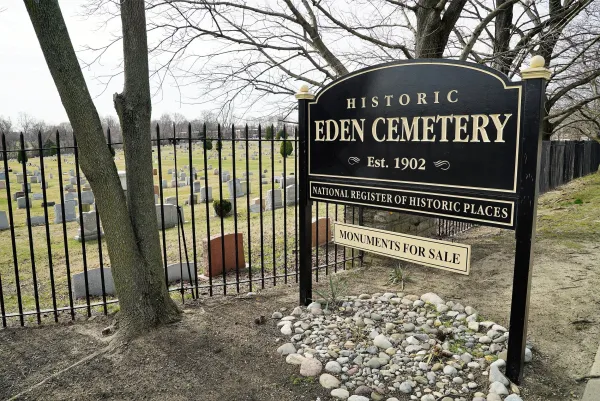
Jackson's obituary in the Lexington Herald-Leader (October 7, 1918, page 10) is available via Newspapers.com. Jordan C. Jackson Jr. is interred at Cove Haven Cemetery, Lexington, Kentucky; Eliza "Belle" Mitchell Jackson, who survived him by 24 years, is buried alongside him.