Yesterday's Architects · The Black Executive Journal™ Jefferson, TX / Rowlett, TX / Dallas, TX · c. 1848–1933 · Agriculture, Fuel Supply & Community Building
At a Glance
- Born into slavery around 1848 in Jefferson, Texas, the hub of East Texas's plantation economy
- Married Moses Calloway in 1862 in Jefferson — both born enslaved; together they moved to Rowlett, Texas, after emancipation and started as sharecroppers
- Converted sharecropping into outright farm ownership — their 100-acre Dallas County farm was assessed at $15,150 in 1882 (approximately $423,000 today), placing them among the most propertied Black families in the region
- When a white man grabbed her cotton bale as it emerged from the gin, she struck him with the cotton hook she was carrying, splitting his skull; he died; a white witness took the blame; she was never prosecuted
- After her husband's death in the late 1880s or early 1890s, she managed the farm alone — raising eleven children, taking her own cotton to the gin, and defending her property
- Sold the farm, retained the timber rights, and moved to Dallas — where she built a railroad-yard coal and log business with her sons that became one of the largest of its kind in the city
- Acquired additional land near the site of what is now the State Fair of Texas grounds; built a home on Collins Street with a veranda running the length of the house and bought a Model T Ford
- Co-founded Macedonia Baptist Church with Rev. A.R. Griggs in 1884 — a congregation that grew into the Good Street Baptist Church, eventually reaching 5,000 members
- Founded a women's lodge within the Household of Ruth in the 1920s; fed the hungry during the Great Depression alongside her daughter Maggie
- Died in her home on Collins Street in 1933 and was buried in the family plot in Rowlett — never having learned to read or write, but reportedly having developed her own private shorthand system
- Her descendants held regular family gatherings into the 1990s and maintained detailed records of the family's roots
The cotton hook was in her hand because she worked with it every day
When the man reached out and grabbed her bale as it emerged from the gin — her cotton, her crop, the product of her labor on her own 100-acre farm in Dallas County — Jane Johnson Calloway did not pause to consider the social calculus of a Black woman striking a white man in post-Reconstruction Texas.
She struck him.
The hook split his skull.
He died.
A white witness who saw what happened apparently stepped forward and took the blame. Jane was never prosecuted.
She went home.
She kept farming.
This moment — quietly documented in the Texas State Historical Association's Handbook of Texas, sourced from a 1986 Dallas Morning News piece — is the key that unlocks the rest of Jane Johnson Endsley's life. She was not a woman who navigated the post-Reconstruction South by keeping her head down.
She navigated it by being so clearly, undeniably in the right — and so embedded in the community around her — that even a white Texas court system could find no traction against her.
She built that position deliberately, one acre and one relationship at a time, over the better part of eight decades.
By the time she died on Collins Street in Dallas in 1933, she had outlived Reconstruction's collapse, the nadir of American race relations, the Great Depression's first years, and four husbands.
She had built a farm worth over $400,000 in today's dollars, converted it into the largest coal and fuel business of its kind in Dallas, co-founded a church that would grow to 5,000 members, and fed her neighbors during the worst economic crisis in American history.
She never learned to read or write.
She developed her own shorthand instead.
From Plantation to Deed: The Making of a Landowner
Jane Johnson Endsley was born a slave in Jefferson, Texas, in 1848.
Jefferson was the commercial capital of East Texas at mid-century — a port city on Big Cypress Bayou whose cotton economy made it one of the wealthiest places in antebellum Texas.
The plantation system that sustained it was among the most entrenched in the state.
She married Moses Calloway in 1862 in Jefferson. Moses had also been born a slave, in Tennessee. They moved to Rowlett, Texas, sometime between 1865 and 1868. The Calloways became sharecroppers but ultimately acquired their own 100-acre farm there.
They had eleven children.
The transition from sharecropper to farm owner is the first major economic achievement of Endsley's life, and it deserves to be understood in its full context. Sharecropping was designed to fail.
The system that replaced formal slavery across the post-bellum South locked Black farmers into arrangements where the landlord provided land and equipment, the farmer provided labor, and the split of the crop — typically 50 percent — was calculated against a running debt for seed, tools, and supplies that the landlord controlled.
The arithmetic almost always favored the landlord. After the war, freed slaves flocked to Dallas in search of jobs and settled in freedmen's towns on the periphery of the city.
Most stayed peripheral.
The Calloways did not.
By 1882, their farm had been formally assessed at $15,150 — approximately $423,000 in today's dollars. This was not a subsistence operation. It was a capitalized agricultural enterprise producing cotton for the commercial market in Dallas County, with a valuation that placed the Calloway family among the most propertied Black households in the region.
They had escaped the sharecropping trap through a combination of discipline, strategic crop choices, and the kind of accumulated local reputation that translated into access to land ownership when that access was available.
The Cotton Hook and What It Meant
After her husband's death sometime in the late 1880s or early 1890s, Jane continued to manage their prosperous farm. She regularly delivered her own cotton to the local cotton gin.
On one occasion, a white man attempted to steal her bale of cotton by grabbing it as it emerged from the gin. "Without thinking," Jane struck him with the cotton hook she was holding, splitting the man's skull.
She was never prosecuted for striking the man, since another white man who witnessed the accident apparently took the blame for it.
The legal outcome — a white witness absorbing liability for a Black woman's act of self-defense — requires examination. Jane Endsley did not escape prosecution by accident.
She escaped it because she had spent decades building a specific kind of standing in her community: a widow managing a hundred-acre farm with documented ownership, a track record of commercial dealings at the local gin, a reputation that extended across racial lines.
The white witness who stepped forward did so in a context where Endsley's position was strong enough that protecting her was viable. This is what genuine community embeddedness looks like in practical terms: not just goodwill, but the kind of standing that produces action when it matters.
She managed the farm alone after Moses's death — raising eleven children, running the full operation, making commercial decisions about when and where to sell.
She had always been the operational mind of the enterprise.
After her husband's death, there was simply no longer any ambiguity about it.
The Pivot: From Farm to Fuel
At some point in the 1890s or early 1900s, Jane Johnson made the most consequential business decision of her life. She sold the farm.
Not all of it.
Jane Endsley ran the business with the assistance of her sons, Joe, Lube, and Emmett. Around that time she sold the family farm in Rowlett but kept the timber rights to the land and set up a railroad-yard coal and log business in the heart of Dallas.
Retaining the timber rights while selling the underlying land is a sophisticated commercial transaction — it separates the value of the trees from the value of the soil, preserving an income stream and a supply chain for the business she was about to build.
This was not a naive sale.
It was a structured asset conversion designed to fund and supply a new enterprise.
The timing was deliberate.
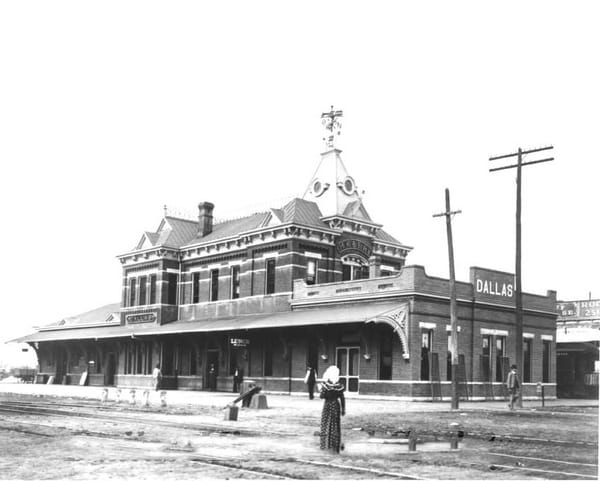
Dallas had secured the Houston and Texas Central in 1872 and the Texas and Pacific in 1873, making it one of the first rail crossroads in Texas. Coal represented the largest category of rail tonnage terminating in Texas by the turn of the century.
A railroad city runs on coal and timber — for heating, for the locomotives themselves, for the construction and maintenance of the rail yards, for the homes and businesses clustering around the tracks.
Endsley read the market correctly: Dallas was a fuel-hungry city at the center of a rail network, and she positioned herself to supply it.
The family company provided much-needed fuel for many Dallas residents and was considered the largest business of its kind in the city. Her sons ran operations alongside her.
The Endsleys acquired another portion of land close to the site of the present State Fair of Texas.
The strategic land acquisition near what would become one of the most commercially significant sites in Dallas reflects the same instinct that had guided her farm — buy land in the path of growth, hold it, and let the city come to you.
Their wealth enabled them to build a fine home on Collins Street, with a veranda stretching the length of the house front, and to purchase a new Model T Ford. The veranda and the automobile were not vanity.
They were visibility — the physical markers of commercial success in a neighborhood where Endsley's standing was the neighborhood's standing.
The Telephone and What It Represented
Endsley had the only telephone in her neighborhood for a long time and welcomed her neighbors to use it.
Dallas acquired its first telephone system in 1881. For much of the late 19th and early 20th centuries, telephone service in Black Dallas neighborhoods was scarce, expensive, and often simply unavailable.
Endsley had one.
She did not treat it as a private asset.
She made it a community resource — a deliberate decision that positioned her home as a hub of practical support and information exchange in a neighborhood that had no other equivalent access point.
This is a pattern that runs through her entire life: converting private wealth into community infrastructure, consistently and without apparent calculation of personal return.
The telephone. The church. The women's lodge. The Depression-era food distribution.
None of these were business ventures. All of them were investments in the social capital that had protected her at the cotton gin, that had built her commercial reputation in Rowlett, that gave her sons a community to operate within in Dallas.
She understood, without ever having articulated it in those terms, that individual Black wealth without collective Black infrastructure was always provisional.
The Church She Built and the Lodge She Founded
In 1884, Rev. A.R. Griggs and Jane Johnson Calloway Endsley organized the Macedonia Missionary Baptist Church to serve the African American Baptist community of Dallas.
The church's historical marker — erected by the Texas Historical Commission in 2015 — documents her co-founding role alongside Griggs explicitly.
After a series of relocations starting in 1907, the congregation settled at its current address in 1950. It grew into what became Good Street Baptist Church, a 5,000-member congregation.
In the 1920s, Endsley helped establish a women's lodge within the Household of Ruth — one of the auxiliary orders connected to the Grand United Order of Odd Fellows, one of the most significant Black fraternal insurance organizations in America.
She rented a building for the lodge's meetings.
This was mutual aid infrastructure: a formal organization providing death benefits, sickness support, and social bonds for Black women in Dallas at a moment when no public safety net served them.
During the Great Depression she and her youngest daughter, Maggie, worked to feed hungry, homeless people. She also spent time ministering to the sick and elderly.
By the early 1930s, Endsley was in her mid-eighties.
She fed people anyway.
What Her Life Teaches
Retain the rights that generate income when you sell the asset that generates capital
When Endsley sold the Rowlett farm, she kept the timber rights.
This single decision preserved her supply chain, created a structural advantage for her Dallas business, and converted what could have been a clean exit into a permanent competitive edge.
In every asset transaction, the question is not simply what the asset is worth today — it is which rights embedded in the asset will generate value in the future.
Read the infrastructure map, not just the current market
Endsley moved to Dallas and built a coal and fuel business at the moment the city was becoming one of the most significant rail intersections in the Southwest.
She did not invent the demand — she positioned herself at the point where existing demand had to flow through.
The entrepreneurs who build the infrastructure that cities run on rarely make the history books.
They make the cities.
Community standing is a business asset with measurable commercial value
The white witness who stepped forward at the cotton gin did so because Endsley's standing in the community made protecting her a viable option. The customers who bought fuel from her sons did so in part because Jane Endsley had been the person who let them use her telephone and who co-founded the church they attended.
Commercial reputation and community standing in Black business history are not separate categories.
They are the same investment.
Endsley did not wait for a legal process, a community response, or a white intermediary when a man stole from her. She acted immediately and proportionately in defense of her property and her labor.
This is not presented here as a general endorsement of violence. It is presented as evidence of a woman who understood, in the most visceral terms possible, that her work had value and that she was prepared to defend it.
Every subsequent business decision she made reflects the same conviction.
Jane Johnson Endsley never learned to read or write. She developed her own shorthand.
She ran a hundred-acre farm, managed complex commercial relationships, negotiated land transactions, built and operated one of the largest fuel businesses in Dallas, co-founded a church, established a women's lodge, and fed her community through the Depression.
The absence of formal literacy constrained her — but it did not define her ceiling.
What defined her ceiling was her refusal to accept that any ceiling existed.
Yesterday's Architects is a biographical series by The Black Executive Journal honoring the Black and African entrepreneurs, executives, and innovators who laid the foundation before us — the dealmakers, the institution founders, the strategists who created industries and wealth across the diaspora when the odds were designed against them.
For Further Study
The essential primary source is Teresa Palomo Acosta's entry on Jane Johnson Endsley in the Handbook of Texas Online, published by the Texas State Historical Association (June 2010), which draws from the 1986 Dallas Morning News profile and Rebecca Sharpless' chapter "'De Useful Life,' 1874–1900" in Black Women in Texas History, edited by Bruce A. Glasrud and Merline Pitre (Texas A&M University Press, 2008).
Millicent Gray Lownes-Jackson's entry on Endsley in Jessie Carney Smith's Encyclopedia of African American Business (Greenwood, 2006) provides the most compact scholarly treatment.
The Macedonia Missionary Baptist Church Texas Historical Commission marker (Marker Number 18186, erected 2015) at 3501 San Jacinto Street, Dallas, Texas, documents Endsley's co-founding role in the institution that became Good Street Baptist Church.
For the Dallas commercial context, the Handbook of Texas entries on Dallas, the Texas railroad system, and the Reconstruction era in Texas — all available at tshaonline.org — provide the most rigorous and accessible background on the economic environment she operated within.
The Rowlett, Texas Historical Museum maintains records of the Calloway-Endsley family farm and burial site.