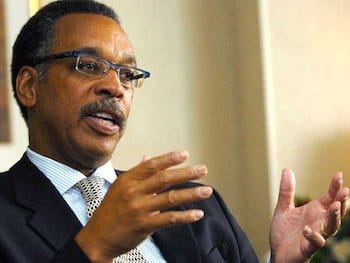
Today's Builders · The Black Executive Journal™ Camden, NJ / Philadelphia, PA / New York, NY · Telecommunications & Civic Leadership · Verizon 1968–2003 · NAACP 2005–2007
At a Glance
— Born February 15, 1946 in Camden, New Jersey; son of two educators, both active in the civil rights movement; played wide receiver at Gettysburg College, graduating in 1968; completed the Sloan Fellows Program at MIT Sloan School of Management in 1988, earning an MS in management; received an honorary doctorate from Gettysburg College in 2006
— Began his career in 1968 as a management trainee at Bell of Pennsylvania — with no particular intention of staying — and spent the next 35 years navigating the most consequential restructuring in American telecommunications history, from regulated monopoly to deregulated competition to the $26 billion Bell Atlantic–NYNEX merger to the creation of Verizon
— Promoted to Vice President of Marketing at Bell Atlantic in 1988; named Group President for Retail in 1993; led the integration team for the Bell Atlantic–NYNEX merger in 1997; became President of Verizon's Retail Markets Group in 2000 — responsible for $23 billion in annual revenue, 35,000 employees, and the company's entire consumer and small-business sales, marketing, and brand management operation
— Ranked #6 on Fortune magazine's list of the "50 Most Powerful Black Executives" in July 2002; named Black Enterprise "Executive of the Year" in 1998; inducted into the American Advertising Hall of Fame in March 2007 — the industry's highest honor; named one of Ebony's "100 Most Influential Black Americans and Organization Leaders" in May 2006
— Retired from Verizon in December 2003 after 35 years; appointed President and CEO of the NAACP in August 2005 — unanimously confirmed by the board, the only candidate seriously considered, and widely regarded as the most unusual selection in the organization's history to that point
— During his 19-month tenure, restored relations between the NAACP and the White House, meeting with President George W. Bush three times in under a year — facilitating Bush's first appearance at an NAACP convention in July 2006; deployed his corporate network to deliver rapid assistance to Black New Orleans residents following Hurricane Katrina; hired senior staff whose reputations stabilized the organization internally
— Resigned in March 2007 after irreconcilable differences with the NAACP's 64-member board over management authority and the organization's strategic direction — specifically, his push to shift the NAACP toward practical social service delivery alongside its traditional civil rights advocacy mission
— Currently serves on the boards of CBS Corporation, Northrop Grumman Corporation, and Tyco International, where he serves as lead director; trustee of U.S. Fund for UNICEF, the National Underground Railroad Freedom Center, and the Newport Festivals Foundation; member of the Advisory Boards for the New York Urban League and Bishop John T. Walker School for Boys; member of the Executive Leadership Council; diversity consultant to Fortune 500 companies
Camden, 1946: A Child of the Movement Who Chose Business
Bruce Gordon grew up in a household shaped by two forces that rarely occupied the same space in mid-century Black America: formal education and civil rights activism. His parents — Walter and Violet Gordon, both teachers — ran a structured home in Camden, New Jersey.
Both were active in the movement.
Gordon absorbed both instincts: the disciplined, credential-based pathway his parents modeled, and the conviction that the conditions Black Americans lived under required deliberate collective action to change.
He chose business.
Not because he abandoned the second instinct but because he believed the first could be weaponized in service of it — that institutional power, accumulated through corporate competence, could be directed toward the same ends as street-level organizing, and might reach places organizing could not.
In 1968, fresh from Gettysburg College where he had played wide receiver and graduated with a BA, Gordon applied for a management trainee post at Bell of Pennsylvania in Philadelphia.
He told Black Enterprise years later that he had no intention of staying.
The regulated monopoly structure of AT&T's Bell system — one company, fixed rates, no competition — seemed to him like exactly the kind of environment that would calcify a career.
Then everything changed.
Thirty-Five Years and the Restructuring of American Telecommunications
What saved Gordon from the stagnation he feared was that he entered the Bell system at precisely the moment it was about to stop being the Bell system.
The antitrust dissolution of AT&T in 1985 created seven regional Bell companies from the wreckage of the monopoly.
Bell of Pennsylvania became Bell Atlantic.
The regulated utility became a competitive business. Suddenly the company needed people who could actually market — who could think about customers as customers rather than ratepayers, who could build brand identity, who could execute against competitors.
Gordon was that person.
He became a sales manager in Bell Atlantic's marketing department in 1972.
By 1976 he was a management supervisor. By 1981 a divisional operations manager. From 1983 to 1985 he oversaw the company's phone center stores. In 1985 he became General Manager of Marketing and Sales.
In 1988 — the same year he completed the MIT Sloan Fellows Program — he was named Vice President of Marketing.
What he did in that role became the model for how a large telecommunications company could actually improve customer service. Bell Atlantic's call centers were answering roughly 70% of incoming calls within 20 seconds.
Gordon set a target of 90% and found the solution not in headcount but in employee behavior — staff were attending seminars and leaving their desks during call volume peaks.
Within two months the company hit the mark.
He also restructured internal advancement, opening all positions to open competition and requiring employees to apply for their own roles — a 20% staff turnover followed, and a significantly more capable organization emerged.
In 1993 he was named Group President for Retail.
In 1997 he was handed the most consequential assignment of his corporate career: lead the integration team for the $26 billion Bell Atlantic–NYNEX merger, which overnight made Bell Atlantic the second-largest telecommunications company in the United States and required rebranding every phone booth, building directory, and 28 million monthly customer statements.
The changeover was executed swiftly and successfully.
Black Enterprise named him Executive of the Year in 1998 specifically for that work, calling him the merger's "maestro."
In 2000, Bell Atlantic merged with GTE and became Verizon. Gordon became President of the Retail Markets Group — responsible for $23 billion in annual revenue, 35,000 employees, and the company's entire consumer and small-business operation across 31 states and the District of Columbia.
Fortune ranked him #6 on its list of the 50 Most Powerful Black Executives in 2002. Verizon CEO Ivan Seidenberg told Black Enterprise that Gordon was "an extraordinary executive whose marketing instincts and skills are unsurpassed."
He retired in December 2003 after 35 years.
The NAACP Appointment Nobody Saw Coming
When the NAACP's board began searching for a new president in 2005 following Kweisi Mfume's departure, the organization was in measurable difficulty. Membership had been declining for years.
Revenue was running a deficit.
The group was approaching its centennial with a $100 million fundraising goal and no clear strategy for achieving it. Its relationship with the White House — under a Republican administration that had shown no particular interest in engaging the organization — was effectively nonexistent.
The board considered one candidate seriously.
It voted unanimously.
Bruce Gordon — former Verizon executive, 57 years old, no background in traditional civil rights organizations, never having run a nonprofit — was confirmed as President and CEO of the NAACP at the July 2005 convention.
The appointment was described at the time as a signal: the organization was looking for someone who could run it like a business.
Gordon said as much himself.
"I intend to go where the trouble is," he told PBS NewsHour. "Once we identify a problem, we will find its solution. If its solution is embedded in political intervention, so be it. If its solution is embedded in building relationships with Wall Street and corporate America, so be it."
What that statement contained, in retrospect, was the precise tension that would end his tenure nineteen months later.
Nineteen Months, Three Meetings with Bush, and an Irreconcilable Disagreement
What Gordon accomplished in nineteen months was not nothing.
He restored the NAACP's relationship with the White House, meeting with President Bush three times in under a year. In July 2006, Bush addressed the NAACP's annual convention — his first appearance at the organization since taking office.
Without Gordon's "moderate" political positioning, which White House spokesman Tony Snow cited directly, the appearance would not have happened.
After Hurricane Katrina struck New Orleans in August 2005, Gordon deployed his corporate network immediately, using relationships built across 35 years of telecommunications to direct resources toward Black New Orleans residents whose needs were not being met by official channels.
Board member Richard Burton called him "the fit" and "the person for the time."
But underneath those visible achievements, the disagreement that would end his tenure was accelerating. Gordon wanted the NAACP to move toward practical service delivery — programs that addressed the concrete conditions of Black life rather than limiting the organization to civil rights advocacy.
The board, led by chairman Julian Bond, disagreed.
"We want it to be a social justice organization," Bond said publicly. "Social service organizations deal with the effects of racial discrimination. We deal with the beast itself."
According to board members and contemporaneous reporting, Gordon had actually tried to resign six weeks after taking the job in August 2005. Bond convinced him to stay.
He stayed for another seventeen months.
Then, in March 2007, he confirmed his resignation from Los Angeles.
"I believe that any organization that's going to be effective will only be effective if the board and the CEO are aligned," Gordon told the Associated Press, "and I don't think we are aligned. This compromises the ability of the board to be as effective as it can be."
He called the misalignment "unhealthy."
He was more direct in other statements.
"I did not step into the role to be a caretaker, to be dictated to," Gordon said. "I stepped into the role to understand as best I could the needs of the African American community and then to propose strategies and policies and programs and practices that could improve conditions for African Americans. The things I had in mind were not consistent with what some — unfortunately, too many — on the board had in mind."
He left by the end of March 2007.
What the Nineteen Months Actually Teach
The Gordon–NAACP episode is frequently reduced to a story about misfit — the corporate executive who didn't understand the civil rights organization. That framing is too simple and misses what actually happened.
Gordon understood the organization.
He had been involved in the Urban League and the United Negro College Fund for decades before taking the role.
What he disagreed with was not the mission but the operating model — specifically, the belief that an organization facing declining membership and a revenue deficit could remain effective by doing exactly what it had always done, governed by a 64-member board that Bond himself acknowledged was "large and sometimes unwieldy."
The argument Gordon was making — that the NAACP needed to evolve from pure advocacy toward a hybrid model that also delivered practical services — was not a corporate imposition. It was a strategic diagnosis.
That the board rejected it is not evidence that it was wrong.
It is evidence that the structural authority to implement it did not exist, regardless of the unanimous vote that had put him in the chair.
This is the leadership lesson that survives the departure: institutional authority and structural authority are not the same thing. Gordon had the title. He did not have the governance architecture to execute his vision.
A 64-member board with a tradition of hands-on oversight is not an environment in which a CEO can operate as a CEO in the corporate sense.
Gordon had spent 35 years in an environment where strategy flowed from the executive suite and boards provided oversight rather than direction. That model does not transfer directly to a membership organization with a century of institutional culture and a board that considers itself the primary steward of the mission.
He is now 79 years old. He serves on the boards of CBS Corporation, Northrop Grumman, and Tyco International.
He is a diversity consultant to Fortune 500 companies.
He remains a member of the Executive Leadership Council — the organization of Black senior executives at Fortune 500 companies that has been a pipeline for corporate Black leadership for four decades.
The 35 years at Bell and Verizon built one of the most consequential careers in Black corporate America. The 19 months at the NAACP produced a leadership case study that business schools have been discussing ever since.
The sharpest executives in any room are the ones who can walk into a new institution, read its actual power structure within weeks, and adjust their approach accordingly — or leave. Gordon read the NAACP clearly.
He stayed longer than his own instincts recommended.
What he said on his way out has outlasted most of what his critics said about him.
Sources
The following sources were used directly in the reporting of this profile. All factual claims are drawn from these documents.
Wikipedia — Bruce S. Gordon Primary biographical reference; education, career timeline, NAACP tenure, board memberships, awards https://en.wikipedia.org/wiki/Bruce_S._Gordon
Encyclopedia.com — Bruce S. Gordon (Contemporary Black Biography) Detailed career history from Bell of Pennsylvania through Verizon retirement; customer service metrics; Bell Atlantic–NYNEX merger integration; mentoring group founding; personal background https://www.encyclopedia.com/people/social-sciences-and-law/social-reformers/bruce-s-gordon
Black Economic Alliance — Bruce S. Gordon biography Final Verizon role confirmed: $23 billion revenue unit, 35,000 employees, advertising and brand management; Advertising Hall of Fame, Ebony 100, Fortune 50 rankings confirmed https://blackeconomicalliance.org/people/bruce-gordon/
Verizon press release — Black Enterprise Names Bell Atlantic's Bruce Gordon Executive of the Year (1998) Award confirmed; $500 million budget reference; merger maestro context; Ivan Seidenberg quote sourced directly https://www.verizon.com/about/news/press-releases/black-enterprise-names-bell-atlantics-bruce-gordon-executive-year
Verizon press release — Fortune Magazine Names Verizon Executive Bruce Gordon to List of 50 Powerful Black Business Leaders (2002) Fortune #6 ranking confirmed; $25 billion revenue figure; 34,000 employees; 31 states confirmed https://www.verizon.com/about/news/press-releases/fortune-magazine-names-verizon-executive-bruce-gordon-list-50-powerful-black-business-leaders
NPR — Board Conflict Prompts NAACP President to Resign (March 5, 2007) Resignation confirmed; 19-month tenure; board conflict details; Hurricane Katrina response; Richard Burton quote; Gordon's advocacy-vs-service-delivery position https://www.npr.org/2007/03/05/7711144/board-conflict-prompts-naacp-president-to-resign
NBC News / Associated Press — NAACP President Bruce S. Gordon Said Sunday He Is Leaving (March 4, 2007) Gordon AP quotes sourced directly; Julian Bond response; 64-member board context; early resignation attempt after six weeks confirmed; Bush relationship details https://www.nbcnews.com/id/wbna17453795
Washington Post — NAACP President Quits, Cites Conflicts (March 5, 2007) Headquarters relocation proposal; Bond quotes on social justice vs. social service distinction; board dynamics confirmed http://www.washingtonpost.com/wp-dyn/content/article/2007/03/04/AR2007030400616.html
African American Registry — Bruce Gordon, Business Executive born "I did not step into the role to be a caretaker" quote sourced and confirmed https://aaregistry.org/story/bruce-gordon-business-executive-born/
Philanthropy News Digest — NAACP President and CEO Resigns Julian Bond "social justice vs. social service" quote sourced directly; 500,000 membership figure; $100 million centennial fundraising goal confirmed https://philanthropynewsdigest.org/news/naacp-president-and-ceo-resigns
Today's Builders is a series by The Black Executive Journal profiling the founders, operators, investors, and executives shaping Black and African business right now — the dealmakers closing rounds, the operators building institutions, the strategists entering new markets and constructing lasting economic infrastructure across the diaspora economy in real time.