Cyrus Bustill: The Baker Who Built Black Philadelphia
He fed Washington's army, co-founded America's first Black mutual aid society, and planted a dynasty that reached Paul Robeson. History buried him for 186 years.

– 8 min read


He fed Washington's army, co-founded America's first Black mutual aid society, and planted a dynasty that reached Paul Robeson. History buried him for 186 years.
Yesterday's Architects · The Black Executive Journal™ Burlington, NJ / Philadelphia, PA · 1732–1806
In 1742, when Quaker lawyer Samuel Bustill died in Burlington, New Jersey, his widow arranged for the sale of Cyrus — ten years old, the lawyer's own son, born to an enslaved African woman named Parthenia — to a fellow Quaker named Thomas Prior.
The terms were unusual.
Prior, a baker by trade, would take the boy on as an apprentice. He would allow him to earn. And at the end of it, Cyrus Bustill would buy himself back.
What Grace Bustill could not have anticipated was what he would do with the freedom once he had it.
By the time he died in 1806, Cyrus Bustill had built a commercial bakery supplying bread to George Washington's Continental Army, accumulated twelve acres of land in Montgomery County, co-founded the first Black mutual aid organization in Philadelphia, seeded the first Black Episcopal church in the United States, and opened a school for Black children out of his own home.
He had done all of it without a single day of formal education, starting from a transaction designed to enrich someone else.
His great-great-grandson was Paul Robeson.
The line from that bill of sale to one of the 20th century's most consequential Black American voices runs straight and deliberate through four generations of intentional family-building.
None of it was accident.
The precise moment of Bustill's liberation is historically contested — and the contestation itself is instructive.
Some sources record that he used accumulated apprenticeship wages to purchase his freedom in 1774. Others document that Thomas Prior freed him by manumission in 1769, making him one of 104 enslaved Africans liberated by Quakers in the Burlington Quarterly Meeting between 1763 and 1796.
What both accounts agree on is the mechanism: a skilled trade, deployed with discipline over years, converted into the currency of liberty.
Bustill learned this lesson at ten years old.
He never stopped applying it.
He married Elizabeth Morey, a woman of Native American and European descent — a union that was itself a quiet act of defiance in a society built on racial hierarchy.
Together they built a family that would carry his values forward for five generations.
When the Revolutionary War broke out, Bustill was among approximately 5,000 African Americans who joined the Continental Army's nearly 230,000 soldiers.
He worked behind the lines as a baker — and his contribution was officially attested. He was commended for supplying American troops with baked goods at the port of Burlington, his faithful service in baking all the flour used at the Burlington docks formally documented in the record.
The story that George Washington personally presented him a silver piece in recognition has circulated for generations and appears in multiple historical accounts. No primary document has surfaced to confirm it.
The commendation for his service is documented.
The silver piece remains family history — which is its own kind of record.
What Bustill understood about the Revolution extended beyond the battlefield. Pennsylvania passed a gradual abolition act in 1780. By 1800, all but 55 of Philadelphia's more than 6,400 Black residents were free.
The republic had rewarded his service with partial justice.
Bustill moved to Philadelphia anyway, opened his bakery at 56 Arch Street, and got to work on the part the republic wouldn't do for him.
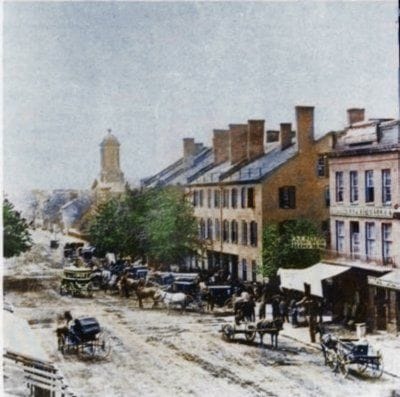
The Philadelphia Bustill found after the Revolution was the largest city in the new nation — and the center of its free Black population. He established his commercial bakery at 56 Arch Street, a fixed address on one of the city's main thoroughfares.
This was not a side operation.
It was a named, permanent business built on consistent quality and a reputation earned across two decades of professional baking.
His business success came from competence, not charity.
His Quaker connections provided a network; his skill provided the credibility that network alone could not. By 1791, that discipline had translated into real property: twelve acres in Guineatown, the Black settlement nestled between Abington and Cheltenham townships in Montgomery County, Pennsylvania.
Land was permanence in 18th-century America. Cyrus Bustill had earned it.
In 1797, after nearly three decades behind the oven, he closed the Arch Street bakery, built a house at Third and Green Streets, and retired.
Most men would have called that a complete life.
Bustill was 65.
The Free African Society was founded on April 12, 1787 — and Cyrus Bustill was at the table.
Led by Richard Allen and Absalom Jones, the Society was the first Black mutual aid organization in Philadelphia and among the first in the United States. Its founding document reads like the charter of a serious financial institution, because that is precisely what it was.
Members contributed one shilling in silver Pennsylvania currency per month. After one year of good standing, the Society paid three shillings and nine pence per week to members in genuine need.
Burial costs covered.
Widows supported.
Children apprenticed into trades.
Tuition paid for those shut out of free schools. No drunkards admitted. No disorderly conduct tolerated.
This was not charity. It was insurance — underwritten by community discipline and collective dues.
Bustill did not just attend meetings. He was among the first to release his personal funds to help establish St. Thomas's African Episcopal Church in 1792 — the first Black Episcopal church in the United States.
He gave money that seeded an institution that would anchor Black Philadelphia for the next two centuries.
The same year the Society was founded, Bustill stood before an audience of enslaved Africans in Philadelphia and delivered a speech on September 18, 1787.
Titled "I Speak to Those Who Are in Slavery," it is the opening entry in Lift Every Voice: African American Oratory, 1787–1900 — the definitive anthology of 113 years of Black American public address.
The editors did not place Bustill first alphabetically.
They placed him first because he was first.
A self-purchased baker was the inaugural voice of the Black American oratorical tradition.
In 1803, Cyrus Bustill opened a school for Black children in his home on Third and Green Streets.
He had never attended school himself.
The irony dissolves once you understand what Bustill had spent 70 years watching. He had seen illiteracy weaponized — in contracts that couldn't be read, in deeds that couldn't be verified, in courts where Black testimony barely counted.
He understood what it cost with the precision of a man who had paid the price personally.
So he built the thing he never had, for the children who came after him.
A year later, Absalom Jones opened another school. By 1837, ten private schools for Black children were operating in Philadelphia, with support from Quakers and the Pennsylvania Abolition Society.
Bustill's school was not the only one. It was among the first. It set the direction.
Cyrus Bustill died in 1806.
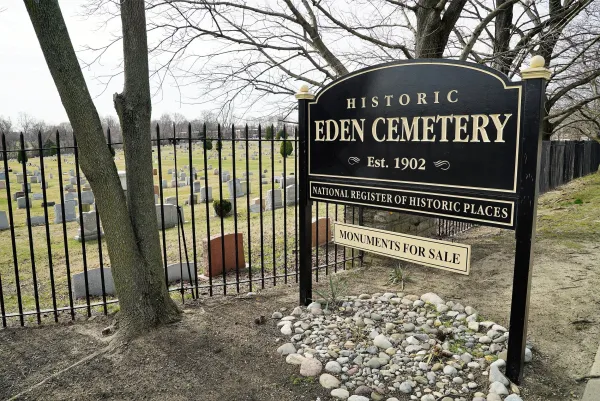
His grave is at Eden Cemetery in Collingdale, Pennsylvania. A Pennsylvania Historical Marker was erected at 210 Arch Street — the site of his bakery — in 1992.
The math is not subtle: 186 years between a man's death and the public acknowledgment of what he built.
What survived the silence was not a building or a balance sheet. It was a family.
His daughter Grace Bustill Douglass operated a millinery shop and co-founded the Philadelphia Female Anti-Slavery Society alongside Lucretia Mott in 1833.
His grandson David Bustill Bowser sheltered John Brown at his Philadelphia home in 1858, painted his portrait, and went on to make regimental flags for United States Colored Troops during the Civil War.
His granddaughter Sarah Mapps Douglass was an educator, abolitionist, and artist whose botanical illustrations are preserved in museum collections today.
His great-great-grandson Paul Robeson — Rutgers valedictorian, concert singer, actor, and international civil rights figure — named Cyrus Bustill explicitly when accounting for who he was:
"My great-great-grandfather, Cyrus Bustill, who baked bread for Washington's troops, became a leader of the Negroes in Philadelphia; and in 1787 he was a founder of the Free African Society."
That is the real measure of what Bustill built.
Not the bakery, which is gone.
Not the twelve acres, which passed through other hands.
Not even the Free African Society, which dissolved before the 19th century ended.
What compounded across five generations was something harder to quantify and impossible to seize: a family culture of self-determination, of education as obligation, of using every resource available to build something that outlasts the builder.
The bill of sale in 1742 was meant to be the beginning and the end of Cyrus Bustill's story.
He spent the next 64 years making it only the beginning.
A widow's sale could transfer property.
It could not transfer what Bustill had learned in Prior's bakery.
In every era where Black wealth has been subject to legal seizure or social violence, the entrepreneurs who survived and compounded were the ones whose core asset lived in their hands and minds — not on a deed that could be contested.
Bustill navigated Quaker abolitionist networks strategically — not because Quakers were natural allies, but because their principles created leverage he could exploit. He extracted manumission, professional training, business connections, and social credibility from a community that simultaneously profited from slavery.
This is not moral compromise.
It is sophisticated stakeholder management under structural constraint.
Bustill's most durable contribution was not his bakery — it was the Free African Society.
One generation's wealth can be erased by a single legal ruling, a fire, a flood, or a depression. Institutions, when built with discipline, outlast the conditions that created them.
Bustill understood that the community needed a financial chassis before it needed anything else.
A man with no formal schooling opened a school at 71 from his own retirement savings.
He would never personally benefit from what it produced.
That is the definition of intergenerational investment — deploying resources toward a return you will not live to collect.
Robeson did not simply descend from Bustill.
He was shaped by a family culture that Bustill had spent decades deliberately constructing — values transmitted through five generations of educators, abolitionists, artists, and organizers.
What Bustill left was not a fortune.
It was a template.
Yesterday's Architects is a biographical series by The Black Executive Journal honoring the Black and African entrepreneurs, executives, and innovators who laid the foundation before us — the dealmakers, the institution founders, the strategists who created industries and wealth across the diaspora when the odds were designed against them.
The foundational scholarly work on this era is Gary B. Nash's Forging Freedom: The Formation of Philadelphia's Black Community, 1720–1840 (Harvard University Press, 1988).
Julie Winch's Philadelphia's Black Elite (Temple University Press, 1988) covers the Free African Society in close detail. Bustill's 1787 speech is preserved in Lift Every Voice: African American Oratory, 1787–1900, edited by Philip S. Foner (University of Alabama Press, 1998).
A biographical sketch by his descendant Anna Bustill Smith appears in the Journal of Negro History, Vol. 10, No. 4 (October 1925), available through JSTOR. The Bustill-Bowser-Asbury family papers are held at Howard University's Manuscript Division.
His grave is at Eden Cemetery, Collingdale, Pennsylvania.
The Pennsylvania Historical Marker at 210 Arch Street, Philadelphia marks the site of his bakery.