Africa's $100 Billion Annual Gap: How Black Investors Can Get In Before Wall Street Does
Black Executive Journal | Global Markets & Capital | Week 3 of 6 — "Building the 21st Century" Series

– 6 min read


Black Executive Journal | Global Markets & Capital | Week 3 of 6 — "Building the 21st Century" Series

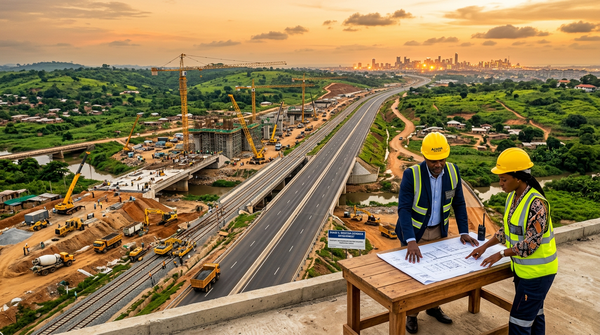
Africa needs between $130 billion and $170 billion in infrastructure investment every year. It currently receives $80 to $90 billion. The gap — conservatively $60 billion annually, possibly $100 billion — is not a funding problem in the conventional sense. It is a project preparation problem.
Less than 10% of planned African infrastructure projects ever reach financial close.
That distinction is everything.
A funding problem means capital is scarce. A project preparation problem means capital is abundant but waiting for the right on-ramp — and the on-ramp hasn't been built yet.
For Black American investors, diaspora entrepreneurs, and African business leaders with financial structuring experience, that on-ramp is the business opportunity.
2% — the annual reduction in GDP growth Africa absorbs because this infrastructure gap is not being filled. Compounded over a decade, that shortfall represents trillions in foregone economic output, foregone business revenue, and foregone wealth creation across the continent.
It is also, by the same logic, the value that flows to whoever closes the gap.
The African Development Bank has quantified the need with precision.
Former Senegalese Economy Minister Amadou Hott has stated publicly that Africa needs to multiply its current project-preparation efforts "by 100 or even 150" to meet demand.
The bottleneck is upstream of financing entirely. Projects fail to reach bankable status because:
The consequence is that the world is not short of capital seeking African infrastructure — it is short of projects structured well enough to receive that capital.
Private equity funds, development finance institutions, sovereign wealth funds, and increasingly BRICS-aligned capital are all circling the same set of bankable opportunities.
The bottleneck is preparation, not supply.
Infrastructure demand in Africa is not static.